
Factory guide
What Is a Sintered Stone Basin? Material, Methods, and Honest Trade-offs
A sintered stone basin is formed from sintered stone — minerals pressed and kiln-fired into a non-porous slab. Its stain and heat resistance come from the mineral body — not a glaze (ceramic) or resin binder (quartz). Most are hot-bent over a mold into one piece — no glued seams.
By Vora Surfaces Factory Editorial Team · Published 2026-10-02 · Foshan, China
What “sintered stone” actually means
Start with the name. “Sintering” is an industrial fusing step: a blend of natural minerals — mostly feldspar, silica, and clay, with mineral pigments for color — gets pressed under high pressure into a slab, then fired in a kiln until the particles weld into one vitrified mass. No resin, no cement, no polymer binder. Heat and pressure do the binding.
Out of the kiln comes a slab with near-zero porosity. Water, soap, toothpaste, hair dye — the daily chemistry of a bathroom — sit on the surface instead of soaking in. That single property explains why the material migrated from floors and kitchen counters into bathrooms: a basin spends its entire life wet.
Two distinctions buyers often mix up. Quartz slabs bind mineral particles with resin, and solid surface is resin through and through; sintered stone replaces resin with heat as the binder, so it tolerates hot styling tools and UV exposure that scorch or yellow resin-based materials. Ceramic basins, meanwhile, get their stain resistance from a glaze coating over fired clay — scratch through the glaze and the porous body underneath shows. Sintered stone’s resistance runs through the full thickness of the slab. One caveat: most patterns are printed on the surface rather than running through the body, so a deep chip can expose the base color underneath. More on that in the limitations section below.
How a slab becomes a basin
The material name tells you nothing about construction. A slab turns into a basin by one of three methods, and the method sets both the price tier and where the basin is likely to fail.
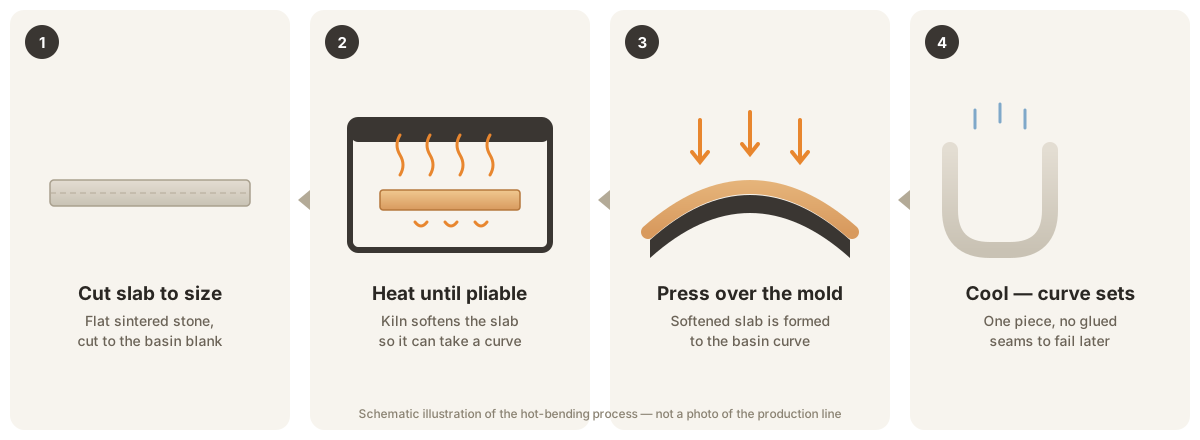
Hot-bent. The slab is heated until pliable, then formed over a mold into a one-piece basin. The bend carries no glued seam. It demands more equipment and operator skill than cutting and gluing, which is why it costs more — and why the joint responsible for most basin failures simply isn’t there. This is Vora Surfaces’ core process, done in-house at our Foshan factory rather than outsourced. (Can sintered stone be bent? answers that question directly, with the shape limits.)
Glued (45° mitered). Flat pieces are cut, mitered at 45°, and glued into a basin shape. Any shop with a saw and a miter jig can do it, so it dominates the market. Every corner is an adhesive seam — a line that can trap grime, discolor with age, and eventually open up.
CNC machined. The basin is carved out of a thick slab on a CNC. Dimensionally precise, but slow and wasteful of material, so it rarely appears in volume production.
When a supplier quotes you a “sintered stone basin,” ask which of the three you’re getting. Two basins can share the material name and share nothing else. We document the bending process in detail in our hot-bent sintered stone basin guide.
Why hot-bending matters for a basin
A basin fails at its weakest point, and on most basins the weakest points are the joints. Glue ages. Thermal cycling — hot water, then cold — works a seam a little more each time. Cleaning chemicals wick in. The failure rarely announces itself; it shows up as a darkening line, then a gap, then a warranty claim.
Hot-bending removes that failure mode at the source. The curve of the basin is the slab itself, bent into shape. Fewer seams also means fewer places for water to sit, which is where the cleaning argument for integrated basins actually starts.
The trade-off sits on the manufacturing side: bending needs a kiln, a mold for each basin profile, and operators who can read the material. That capital cost is exactly why most suppliers glue. When you see a wide price gap between two “sintered stone basins,” the construction method is usually the explanation. Our hot-bent vs glued decision guide lays out the trade-offs buyer by buyer.
Sintered stone vs ceramic, quartz, and solid surface
| Sintered stone | Ceramic | Quartz | Solid surface | |
|---|---|---|---|---|
| Base material | Fused natural minerals, no resin binder | Fired clay with glaze | Minerals bound with resin | Resin-heavy composite |
| Porosity | Near zero | Low (glaze-dependent) | Very low | Very low |
| Stain resistance | High — non-porous body | High while glaze intact | High, but strong dyes can mark resin | Good, marks sand out |
| Heat tolerance | High — no resin to scorch | High | Limited — resin binder scorches | Limited — resin softens |
| Repairability | Difficult — a chip is a chip | Difficult | Difficult | Easy — sands and refinishes |
| Design range | Any slab pattern, large formats | Molded shapes, glaze colors | Slab patterns | Seamless, thermoformable |
| Typical price tier | Mid to high | Low to mid | Mid | Mid |
How to read this: sintered stone wins where the body itself does the work — heat, stains, UV — because there is no resin and no glaze to fail. It loses where its hardness works against it: a chip can’t be sanded out the way solid surface can. Match the material to the failure your customers actually complain about. If callbacks come from stained, scorched, or sun-faded basins, sintered stone earns its price. If they come from chipped edges in rental units, the repairability of solid surface may matter more.
Three basin constructions you’ll see on quotes
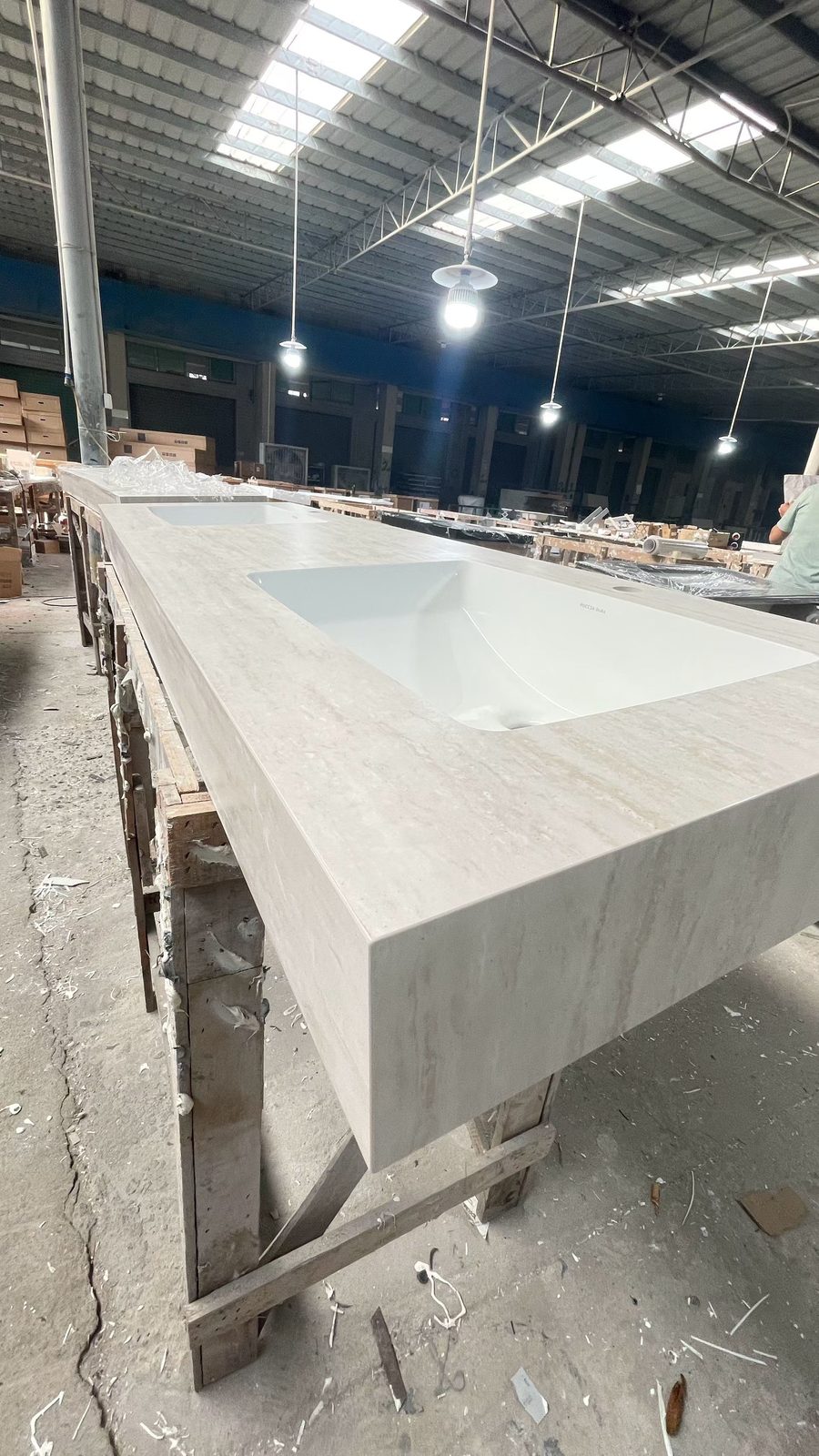
Integrated (one-piece). Basin and countertop formed as a single piece — the natural pairing for hot-bending. No rim, no caulk line, no lip for water to sit behind. The default for wall-hung vanity programs.
Top-mount (drop-in). The basin drops into a cutout, rim resting on the counter. Simplest to install and cheapest to replace; the rim edge collects water and grime over its life.
Undermount. The basin hangs beneath the counter with the cutout edge exposed. Clean sight lines, but the basin-to-counter joint needs sealing and periodic attention.
For B2B vanity programs, integrated wins on hygiene and perceived value; top-mount wins on installation simplicity and replacement cost.
The honest limitations
No material wins every category. Here’s where sintered stone costs you:
Chips are permanent. Drop something heavy on an edge and the damage stays. A fabricator can sometimes round off a small edge chip and re-polish it, but the printed pattern layer doesn’t extend through a deep chip — the base body color shows, and no field repair restores the original face. If your buyers are rough on edges, say so upfront and design edge profiles accordingly.
It’s heavy. A sintered stone top weighs noticeably more than ceramic or solid-surface equivalents. Wall-hung installations need proper structural support — flag it in the quoting conversation so the installer plans for it.
Patterns are skin-deep. Most sintered stone patterns are printed onto the slab surface rather than running through the full body. From normal viewing distance the effect is convincing; at a chipped edge or a fresh cut, the difference shows.
It costs more than ceramic. Material, kiln time, and mold investment all price in. The value case is lifecycle: fewer stain and heat callbacks over the years.
Installation quality decides the outcome. Uneven cabinet support creates stress points, and hairline cracks form around cutouts and corners when a top isn’t bedded flat. Installers see this pattern often: the stone takes the blame for a bedding problem. Vet the installer with the same care you vet the supplier.
Sizes and how to specify
Vora Surfaces builds integrated hot-bent basins in the 600–1200 mm width range, with around 40 catalog models. Because the bending is done in-house rather than outsourced, custom profiles across the hot-bent basin and vanity category are workable — the catalog is a starting point, not the boundary. Large-format slabs (industry spec charts list sizes up to 1600×2800 mm in 6–12 mm thicknesses) are what make seamless wide basins possible in the first place.
Exact dimensions vary by model — request the datasheet for the models you’re quoting. Browse the product range, and for delivery: every basin leaves the factory wrapped in protective foam and crated in wood with internal framing and strapping.
Sourcing sintered stone basins for a vanity program or project? Send your target models, widths, and quantities — we’ll come back with a quote and datasheets. Request a quote · Browse products · or email [email protected].
Frequently asked questions
Can sintered stone be bent?
Yes. In hot-bending, the slab is heated until pliable, formed over a mold, then cooled so the curve sets permanently — producing a one-piece basin with no glued seam at the bend.
Is a sintered stone basin better than a ceramic basin?
For stain and heat resistance, yes: the non-porous mineral body outperforms a glaze coating that can scratch through. Ceramic wins on price and shape variety. Choose by which failure mode costs you more.
Can a chipped sintered stone basin be repaired?
Not really. A small edge chip can sometimes be rounded and re-polished by a fabricator, but a deep chip exposes the base body color beneath the printed pattern, and no field repair restores the original surface.
Does a sintered stone basin need sealing?
No. Sealers close the pores of natural stone; sintered stone has effectively no pores. Clean with normal bathroom cleaners and avoid leaving strong dyes sitting on the surface.
Can you pour boiling water into a sintered stone basin?
Yes. With no resin binder to scorch or soften, the material handles heat that damages quartz and solid surface basins.
What sizes does Vora Surfaces make?
Integrated hot-bent basins in 600–1200 mm widths, around 40 catalog models, with custom profiles available across the category since bending is done in-house.
Sourcing hot-bent basins for your next project?
Send your drawings and target quantities — we'll confirm feasibility from the factory floor.
Configure your inquirySpecifications verified against Vora Surfaces factory records. Editorial review applied.