
Factory guide
When the Faucet Finish Fails First: Peeling, Chipping, and Tarnish Dealers Should Spec Against
Faucet finish failure is the visible breakdown of a faucet’s surface layer — peeling, chipping, flaking, or discoloration that exposes the metal beneath. It shows up months or years after installation, on the spout, handles, and base ring, where hands, water, and cleaning products meet the coating daily. For dealers, it matters because the faucet is the part of a basin set buyers touch daily, so a failing finish is the complaint that reaches the dealer.
By Vora Surfaces Factory Editorial Team · Published 2026-11-17 · Foshan, China
The posts that put this on the map
Evidence: owners and trade posters, named with the date they posted. Finish life varies with the coating process, the water, and how often a faucet is used, so one owner’s experience does not set the rule for another.
On 23 September 2026, @theturnerhouseproject posted photos (1.3K likes, 88 comments) of a matte black faucet from a 2018 renovation: the coating had peeled away in large areas, brass showed beneath, and the matching black door handles had worn the same way. On 28 June 2025, @jay_lina_decor wrote (71 comments) that a matte black faucet started peeling in under a year and the whole set had to be replaced. A plumber’s video from 27 May 2026 advised against matte black, saying water marks and soap residue show on it, and a showroom salesperson, posting on 13 June 2025 to 5.1K likes, warned that ordinary cleaning can damage the coating.
The counterpoint comes from designer Phoebe O’Neill, whose 20-page carousel from 5 October 2026 drew 1K likes and 180 comments. She wrote that unlacquered brass, sold as a finish that gains character with age, reads as dirty in daily use: brass reacts with air, water, and skin oils, so touch points end up uneven. Her advice: lacquered or satin brass on touch points, polished nickel for the faucet, and no unlacquered brass in the shower, where it turns green. A VOLGA plating advertisement makes the same point from the supply side: coating quality varies between makers.
The shared thread is timing: finish failure appears months or years after the sale, when the buyer looked at colour alone.

Four ways a faucet finish fails
Peeling and flaking. The coating lifts in sheets or flakes, and the base metal shows through — in @theturnerhouseproject’s photos, large areas of black gone, brass beneath.
Wear-through at touch points. Handles and spout edges lose coating where hands grip them daily, as the matching door handles in the same post show.
Water-spot and soap visibility. Dark finishes show mineral deposits and soap residue that a lighter finish would hide. It is the reason to think twice about matte black: the finish may hold up while the surface looks marked after every use. In a hard-water area, deposits gather at the base ring and spout.
Greening and uneven tarnish on unlacquered brass. Bare brass reacts with air, water, and skin oils, so touch points end up uneven in colour, and the finish turns green in a shower. The colour change is bare brass doing what bare brass does, and buyers who expected a steady golden tone read it as dirt.
What the finishes are, in plain terms
The table below uses general industry knowledge and carries no Vora test conclusion: the faucet finish is a buyer spec item to confirm with the faucet maker.
| Finish | How the surface is made | Wear behaviour | Care note |
|---|---|---|---|
| PVD | A thin coating applied in a vacuum chamber | Relatively more wear-resistant than paint-style coatings | Follow the maker’s cleaning instructions |
| Electroplated chrome or nickel | A metal layer deposited by electroplating | The chrome layer can peel when plating quality is poor | Ask the maker which cleaners are safe before the first clean |
| Painted or powder-coated matte black | A colour layer sprayed or powder-coated onto the base | Peeling reported by owners; water marks and soap residue show in plain view | Ask the maker which cleaners are safe before the first clean |
| Lacquered brass | Brass with a clear protective lacquer | Slows the reaction with air and water; touch points wear with use | Use lacquered or satin brass on parts hands touch |
| Unlacquered (“living”) brass | Bare brass, with no protective layer | Colour changes as brass reacts with air, water, and skin oils; turns green in a shower | Keep it out of the shower; expect uneven colour at touch points |
| Polished nickel | A nickel layer, polished bright | Chosen by the designer for the faucet itself; water spots still show | Wipe after use in hard-water areas |
Two cautions: “relatively more wear-resistant” describes PVD against paint-style coatings in general industry terms, and says nothing about how long a given maker’s coating lasts. How a finish ages comes down to the maker’s process, the water, and the cleaning routine.
Hard water makes dark finishes look worse
Hard water leaves mineral deposits where water stands and dries — on a faucet, the base ring and the spout. On a dark matte finish, each deposit shows as a pale ring or a dull patch, with soap residue filming on top. A buyer in a hard-water area who chose matte black for the look can end up wiping the faucet after every use.
A bathroom that stays damp strains every surface in it — Mold inside a vanity with no leak may be condensation. For the faucet, weigh a lighter or satin finish against dark matte in hard-water areas, and ask the maker for cleaning instructions before the order ships.
Cleaning: the quiet finish-killer
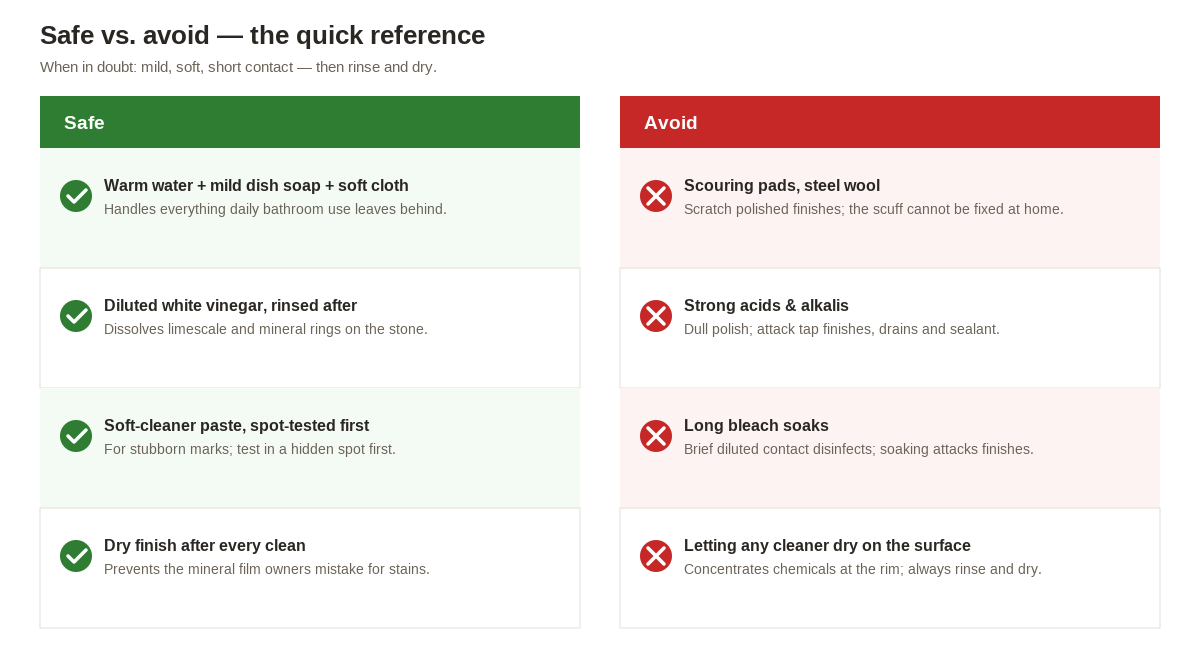
As the showroom salesperson warned, ordinary cleaning can damage the coating: abrasive pads, scouring powders, and harsh chemical cleaners wear it from the outside, and the damage shows as dull patches and lifted edges. The routine that protects a finish is unglamorous: a soft cloth, a maker-approved mild cleaner, and a wipe after use where water is hard. Basin care follows the same rhythm — a weekly wipe-down and a deep clean every two weeks — and the faucet deserves a line in the same routine. Ask for the maker’s cleaner list in writing before the order ships, and pass it to the buyer with the faucet.
The dealer spec checklist
Use this list before the order goes in.
- Ask the maker to name the finish process: PVD, electroplated, painted or powder-coated, lacquered, or unlacquered.
- Ask for the maker’s cleaning instructions in writing, before the order ships.
- In hard-water areas, weigh a lighter or satin finish against dark matte black.
- For handles and other touch points, weigh lacquered or satin brass over unlacquered brass.
- Keep unlacquered brass out of the shower, where it turns green.
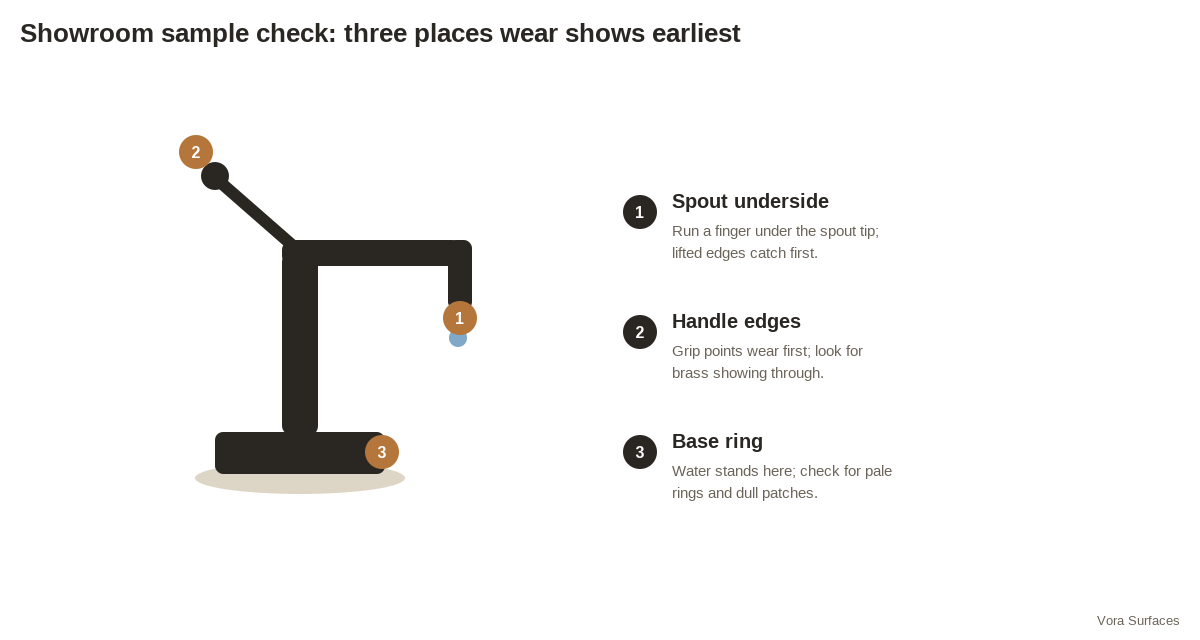
- Inspect a showroom sample at the spout underside, the handle edges, and the base ring — the three places wear shows earliest.
- Confirm the basin tap-hole size against the faucet base size before ordering.
- Record the finish choice on the order, with the maker’s cleaning note attached.
The Twelve QC checks for a bathroom vanity order cover the basin, cabinet, hardware, mirror, finish, and packing; the finish check is the place to record what the faucet finish looked like on arrival.
What to tell a buyer who reports peeling
Whether a faucet is defective turns on what the buyer sees, what the record says, and what happens next, so the honest reply covers all three.
A workable script: “The coating has worn through at the touch points after [time in use]. Here is the maker’s cleaning guidance, and here is what we recorded on the order. I will take this to the maker with the photos and the order record, and come back to you with their response.”
Ordering the basin to match the faucet
The faucet and the basin arrive as one set, so the order has to treat them as one set. Vora hot-bent sintered stone basins leave the factory with pre-drilled faucet holes, and mainstream mixer tap specs are supported — confirm the hole size when ordering, against the faucet base size in item 7. A hole drilled for one faucet and a base sized for another is a mismatch that only shows up on installation day.
Browse the basin and vanity range on the products page, and build the set in the configurator. Buyer terms are collected on the page for buyers. The cabinet line sits in the collections; the faucet finish stays a buyer spec item, recorded on the order.
Request a quote
Ordering basin and vanity sets? Contact Vora Surfaces with the finish process, the water conditions, and the tap-hole size. A member of the Vora team replies to the inquiry, the details are used for this inquiry alone, and no mass mailings follow.
Frequently asked questions
Is matte black faucet peeling normal?
Peeling has been reported by owners within a year of installation, and by others after several years of use. Finish life varies with the coating process, the water, and how often the faucet is used, so one owner’s timeline does not set the rule for another. Before ordering, ask the maker to name the finish process and to share its cleaning instructions in writing.
Can unlacquered brass greening be cleaned off?
Greening comes from brass reacting with air, water, and skin oils, and it returns on bare brass in a shower. Designer Phoebe O’Neill’s advice, from her October 2026 carousel, is to use lacquered or satin brass on parts hands touch, polished nickel for the faucet, and to keep unlacquered brass out of the shower. Cleaning guidance for a specific faucet comes from its maker.
What finish should I choose for a hard-water area?
In a hard-water area, weigh a lighter or satin finish against dark matte black, because dark finishes show mineral deposits and soap residue in plain view. Ask the maker for its cleaning instructions before the order ships, and check the deposits at the base ring and around the spout on a showroom sample.
How do I check a faucet finish before ordering?
Ask the maker to name the finish process, ask for its cleaning instructions in writing, and inspect a showroom sample at the spout underside, the handle edges, and the base ring. Confirm the basin tap-hole size against the faucet base size, and record the finish choice on the order with the maker’s cleaning note attached.
Does peeling mean the faucet is defective?
Whether peeling counts as a defect turns on the maker’s instructions and what the dealer recorded on the order. Finish life varies with the coating process, the water, and how often the faucet is used. A dealer who can show both has a clear basis for the conversation with the buyer.
Specifications verified against Vora Surfaces factory records. Editorial review applied. Spotted an error? Email corrections to vorasurfaces@gmail.com.
Frequently asked questions
Is matte black faucet peeling normal?
Peeling has been reported within a year of installation, and by others after several years. Finish life varies with the coating process, the water, and how often the faucet is used. Before ordering, ask the maker to name the finish process and share its cleaning instructions in writing.
Can unlacquered brass greening be cleaned off?
Greening comes from brass reacting with air, water, and skin oils, and returns on bare brass in showers. Designer Phoebe O'Neill's advice is lacquered or satin brass on parts hands touch, polished nickel for the faucet, and no unlacquered brass in the shower. Cleaning guidance for a specific faucet comes from its maker.
What finish should I choose for a hard-water area?
In a hard-water area, weigh a lighter or satin finish against dark matte black: dark finishes show mineral deposits and soap residue. Ask the maker for its cleaning instructions before the order ships, and check the base ring and spout on a sample.
How do I check a faucet finish before ordering?
Ask the maker to name the finish process and share cleaning instructions in writing, inspect a showroom sample at the spout underside, handle edges, and base ring, and confirm the tap-hole size against the faucet base size before recording the choice on the order.
Does peeling mean the faucet is defective?
Whether peeling counts as a defect turns on the maker's instructions and what the dealer recorded on the order.
Sourcing hot-bent basins for your next project?
Send your drawings and target quantities — we'll confirm feasibility from the factory floor.
Configure your inquirySee the products behind these guides: production cabinet styles and buying terms for buyers & OEM.
Specifications verified against Vora Surfaces factory records. Editorial review applied. Spotted an error? Email corrections to vorasurfaces@gmail.com.