
Factory guide
What to Check When Your Vanity Arrives: Delivery Inspection Guide
When your vanity arrives, inspect the crate and the stone before you sign the delivery note. A signature confirms the shipment arrived in acceptable condition, and a crack found after signing turns a replacement into a negotiation. This guide covers the receiving routine: crate, stone, basin, cabinet, mirror, hardware, and piece count — plus how to document damage and when to refuse.
By Vora Surfaces Factory Editorial Team · Published 2026-10-16 · Foshan, China
In short: Open the crate before signing. Check corners, edges, tap deck, basin bowl, and pre-drilled holes. Photograph damage with the crate open, note it on the delivery note, and refuse cracked stone. Ask for a replacement unit with photo or video proof before it ships.
Why the first five minutes matter
Damage on arrival is a known category of vanity complaint. Amazon’s aggregated reviews put “damage upon arrival” at 6.8% of negative feedback for stone vanities. A Wayfair reviewer in Hamburg, Pennsylvania, described the experience in one sentence: “the first one arrived cracked all the way across.” A Wayfair complaint logged on gethuman tells the worse version: the vanity “arrived broken twice,” and the buyer’s “construction plans are now on hold.” One careful inspection at the curb is your cheapest chance to catch that damage before it becomes your problem.
Before the truck arrives
Clear a flat space to lay the stone top down: a clean floor, sawhorses with blankets, or cardboard on the ground. Keep a tape measure, a flashlight, a charged phone, the order sheet, and the packing list within reach.
The signer should open the crate. If a contractor receives on your behalf, send them this checklist and the order sheet, and ask them to photograph everything before signing. Also check the route into the room: Measure the route as well as the room.
Step 1: Inspect the crate before you open it
Photograph all four sides, the top, and any labels. Look for crushed corners, broken slats, punctures, water staining, and strapping that has shifted or snapped. Each mark tells you where to look hardest inside.
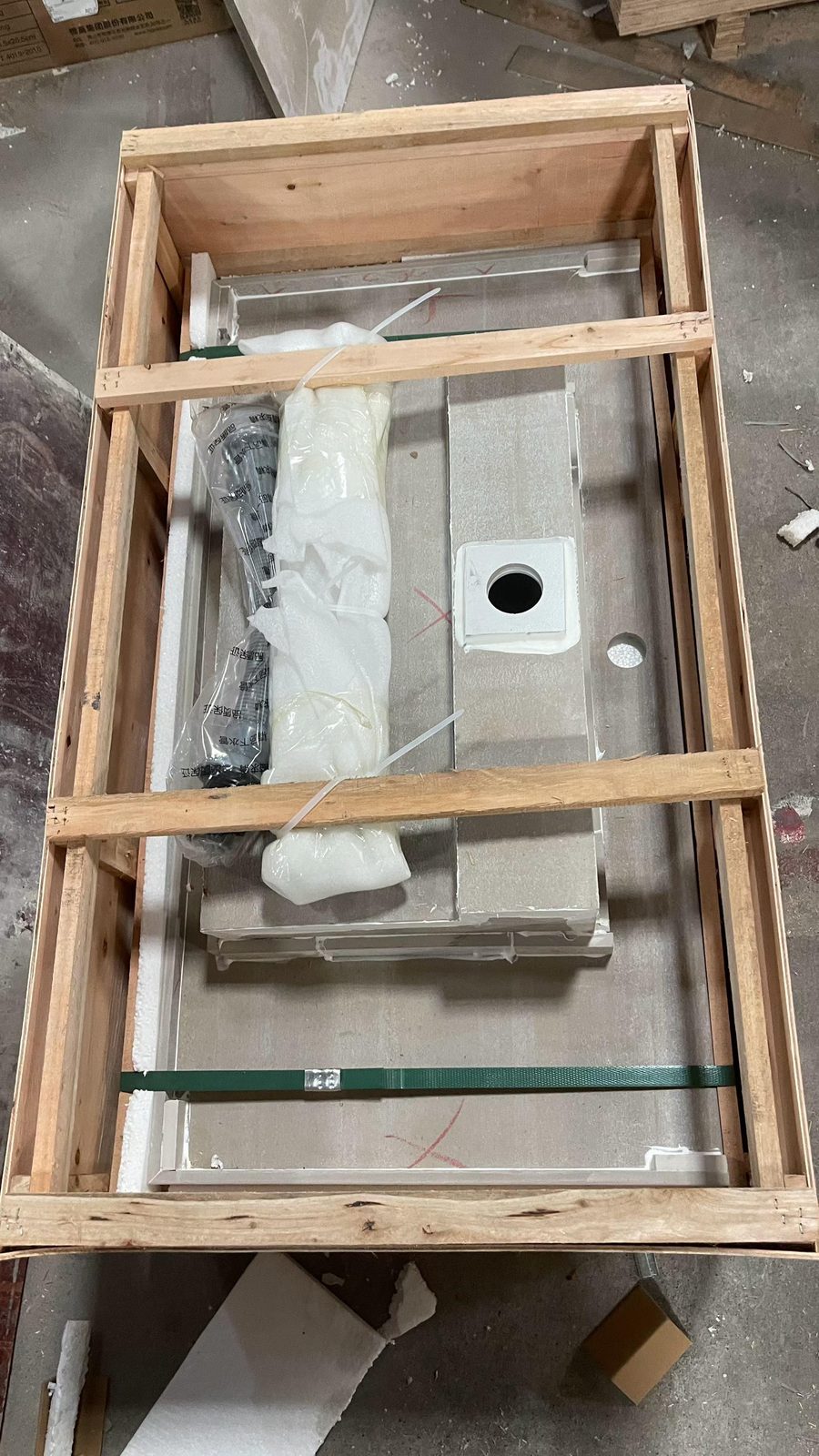
Crate damage alone does not mean the stone is damaged. It means the shipment took a hit, so the stone inspection gets extra care. At our Foshan factory, each basin travels foam-wrapped in a wooden crate with internal wooden framing and strapping holding the load rigid. If the crate shows heavy damage, photograph it before opening and keep the driver present while you open it.
Step 2: Open the crate and inspect the stone
Open the crate with the driver present when possible. Lift the stone top out with two people and lay it flat on the prepared surface. Never prop a stone top on a corner: stone is rigid and brittle, and a top resting on a corner takes its full weight on the most fragile point.
Work through the checklist in order. Use the flashlight at a low angle — raking light shows hairline cracks that overhead light hides. Run a fingertip along every edge.
| Check | What to look for |
|---|---|
| Crate condition | Crushed corners, broken slats, snapped strapping, punctures |
| Stone corners and edges | Chips, flakes, cracks starting at a corner |
| Tap deck | Cracks radiating from tap holes, chips at hole rims |
| Basin bowl | Hairline cracks along the curve, chips on the rim |
| Pre-drilled holes | Count, positions, rough sizing vs order sheet |
| Cabinet, mirror, hardware | Dents, scratches, cracked mirror glass, bent hinges |
| Piece count vs packing list | Every item on the list present and accounted for |
Check the tap deck and basin bowl with particular care. Cracks often start at a hole rim and travel outward, and the basin curve is a second stress zone: run the flashlight slowly along the inside of the bowl and watch for a thin line that catches the light. Stone vanities crack in transit far more often than they crack in use.
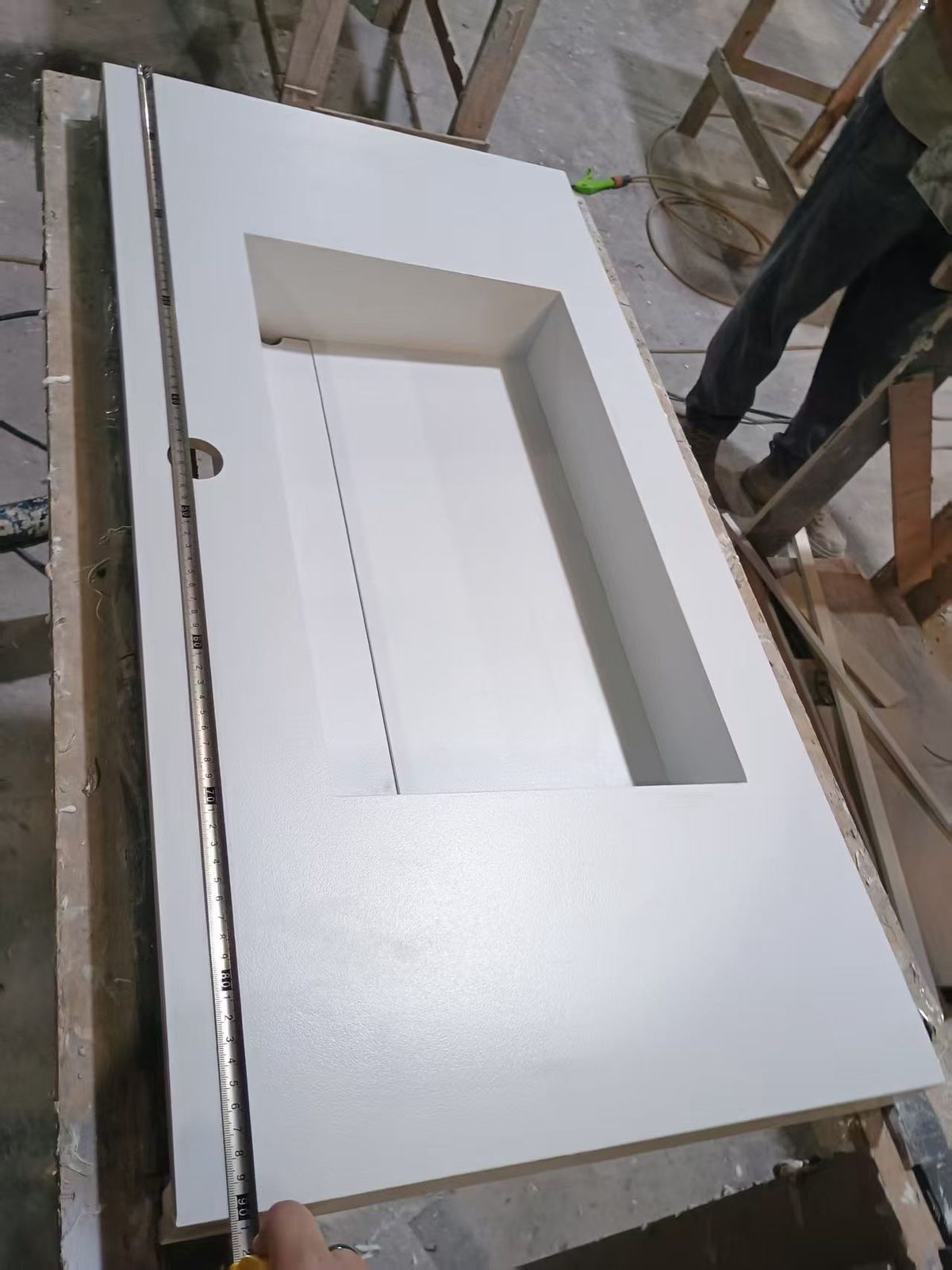
Confirm the pre-drilled holes against your order sheet: count, positions, and rough sizing. Vora basins leave the factory with tap holes pre-drilled for mainstream mixer tap specs, with hole sizing confirmed at order time. A hole in the wrong place is a factory error to catch now, because hole positions cannot change after the stone is cut. Measure the finished unit against the order sheet, too — width, depth, and basin-center positions.
Step 3: Check the rest of the set
Open each remaining package and check every piece before the driver leaves.
Cabinet. Look over the cabinet body for dents, scratches, and damage to corners and door fronts. Open and close each door and drawer: hinges and runners should move smoothly and sit square. Our cabinet bodies are solid wood with moisture-proof treatment, and hardware is Kubo/DTC or equivalent grade.
Mirror. Inspect the mirror glass for cracks and edge chips, and the frame for dents. If the unit includes a smart LED mirror with touch control and optional anti-fog, confirm the mirror type against the order sheet. A visual check is enough — do not wire or power the mirror during the delivery inspection.
Hardware and piece count. Count screws, brackets, handles, and mounting parts against the packing list. Small-part shortages are a common reason an installation stalls a day after delivery. Mark each item present, noting any shortage on the delivery note.
When to refuse, and when to accept with a note
Three outcomes cover the common cases.
Refuse the shipment. Refuse a stone unit with any crack — hairline or otherwise — and any chip that breaks through the face of the stone. Tell the driver you are refusing, write “REFUSED — CRACKED” with a short description on the delivery note, photograph the note, and notify the supplier the same day. Do not let a cracked unit be installed “temporarily” while a replacement is arranged.
Accept with damage noted. Accept when the stone itself is intact but the crate or outer packaging shows damage, or when a non-stone part shows minor cosmetic damage. Write the damage on the delivery note in plain words — “crate corner crushed, stone inspected, no visible damage” — photograph the note, and notify the supplier the same day.
Accept clean. Accept clean only after the full checklist is done and the stone, cabinet, mirror, and hardware all pass. A clean signature closes the delivery record, so reserve it for a shipment that earned it.
How to document a damage claim
Document with wide shots first, then close-ups:
- Photograph the crate before opening. All sides, labels, and visible damage.
- Photograph the damage with the crate open. The whole top in frame, then a close-up with a coin for scale.
- Photograph the delivery note. Capture your written damage note and the driver’s signature.
- Shoot a short video. A slow walk-around of the open crate and the damaged area, narrating what you see.
- Notify the supplier the same day. Send the photos, the note, and a short description: what arrived, what is damaged, and what you want — a replacement unit.
Ask the supplier to share photos or a short video of the replacement unit before it ships. Buyers on r/askSingapore put it bluntly: “Demand complete replacement, and ask for video proof.” For anything the order paperwork leaves open — who pays return freight, claim deadlines, how the replacement ships — confirm with your supplier and carrier in writing.
What happens after a damage claim
A damage claim for a cracked basin usually ends in replacement or repair. The trade treats those two outcomes very differently.
Replacement means a new unit, made to the same order sheet, checked and packed the same way. Ask for photo or video proof of the replacement before it ships.
Repair or discount means you keep the damaged unit and accept compensation. Field repair has a real but narrow place. Small edge chips can be rounded and re-polished by a skilled fabricator. A crack is a different matter: a repaired crack carries no structural confidence, and the pattern layer around the repair changes color once ground. The stone trade treats accepted repair work as a discount-tier outcome — one fabricator in a long-running r/CounterTops thread put the compensation for accepted repair work at “maybe 10%” off. Buyers on r/askSingapore rejected the premise harder: “What does 95% fix to original mean?… 95% payment then.”
Honest limits: what inspection can and cannot do
A delivery inspection catches the damage you can see and feel: cracks, chips, dents, shortages, wrong holes. It cannot catch every latent issue. A hairline crack under a foam pad, a stress point that opens weeks later under load, a cabinet joint that loosens after a season of humidity — these can pass a careful inspection and still surface later.
Packing has the same limit. Foam wrap, a wooden crate with internal framing and strapping, and a tape-measure check before packing are designed to reduce transit damage. They cannot make damage impossible.
Frequently asked questions
My vanity arrived damaged. What do I do first?
Photograph the damage with the crate still open, write it on the delivery note before signing, and notify the supplier the same day. Refuse a cracked stone unit and ask for a replacement. Confirm claim deadlines and return-freight terms with your supplier and carrier in writing.
Should I sign the delivery note if I see damage?
Sign only with the damage written on the note, or refuse the shipment. A clean signature confirms the shipment arrived in acceptable condition. Photograph the note itself after you write on it.
The crate is damaged but the stone looks fine. Do I still need to do anything?
Yes. Photograph the crate damage, note it on the delivery note, and inspect the stone with extra care. Some cracks only show under a raking light or a fingertip check along the edges.
My supplier offered a repair or a discount for a cracked basin. Should I accept?
A cracked basin calls for a replacement. Field repair suits small edge chips, which a fabricator can round and re-polish. A crack across a basin carries no structural confidence after repair, and the stone trade treats accepted repair work as a discount-tier outcome — one fabricator in a long-running r/CounterTops thread put it at “maybe 10%” off.
Can I ask the supplier for photos or video of the replacement unit before it ships?
Yes, and experienced buyers recommend exactly that. Buyers on r/askSingapore put it bluntly: “Demand complete replacement, and ask for video proof.” Ask your supplier to share photos or video of the replacement unit before it ships.
Ask about a vanity before you order
A delivery inspection goes smoothly when the order sheet is clear. Browse the product line for the current catalogue profiles, or configure your spec with width, basin layout, and hole positions. For a project unit, tell us the basin size, hole layout, and mounting type.
When you send an inquiry, it goes to the Vora Surfaces factory team in Foshan — a real person who answers questions about your specific project. Your details are used for that inquiry only: no mailing list, no bulk follow-ups.
Specifications verified against Vora Surfaces factory records. Editorial review applied. Spotted an error? Email corrections to vorasurfaces@gmail.com.
Frequently asked questions
My vanity arrived damaged. What do I do first?
Photograph the damage with the crate still open, write it on the delivery note before signing, and notify the supplier the same day. Refuse a cracked stone unit and ask for a replacement. Confirm claim deadlines and return-freight arrangements with your supplier and carrier in writing, since those terms vary by order.
Should I sign the delivery note if I see damage?
Sign only with the damage written on the note, or refuse the shipment. A clean signature confirms the shipment arrived in acceptable condition. Photograph the note itself after you write on it.
The crate is damaged but the stone looks fine. Do I still need to do anything?
Yes. Photograph the crate damage, note it on the delivery note, and inspect the stone with extra care. Some cracks only show under a raking light or a fingertip check along the edges.
My supplier offered a repair or a discount for a cracked basin. Should I accept?
A cracked basin calls for a replacement. Field repair suits small edge chips, which a fabricator can round and re-polish. A crack across a basin carries no structural confidence after repair, and the stone trade treats accepted repair work as a discount-tier outcome — one fabricator in a long-running r/CounterTops thread put the compensation for accepted repair work at 'maybe 10%' off.
Can I ask the supplier for photos or video of the replacement unit before it ships?
Yes, and experienced buyers recommend exactly that. Buyers on r/askSingapore put it bluntly: 'Demand complete replacement, and ask for video proof.' Ask your supplier to share photos or a short video of the replacement unit, plus its packing, before it leaves the factory.
Sourcing hot-bent basins for your next project?
Send your drawings and target quantities — we'll confirm feasibility from the factory floor.
Configure your inquirySee the products behind these guides: production cabinet styles and buying terms for buyers & OEM.
Specifications verified against Vora Surfaces factory records. Editorial review applied. Spotted an error? Email corrections to vorasurfaces@gmail.com.