
Factory guide
Are Sintered Stone Basins Durable? Scratch, Stain & Heat Tested
Are sintered stone basins durable? Yes — within clear limits. A third-party lab measured the commissioned sample at 0.07% water absorption, withstood 1.1 kN static load without damage, and showed no cracking or discoloration after 65°C hot-water spray for 60 minutes, on a single tested sample — a single-sample commission test, not product certification. The honest caveats travel with those numbers: exposed edges can chip, deep chips expose the white body and resist invisible repair, and durability depends on the installer.
By Vora Surfaces Factory Editorial Team · Published 2026-10-20 · Foshan, China
In short: Yes, with limits. A commissioned lab test measured 0.07% water absorption, 1.1 kN static load with no damage, and 65°C hot-water spray for 60 minutes with no cracking or discoloration — a single-sample commission test, not product certification — but edges can chip, deep chips expose the white body and resist invisible repair, and durability depends heavily on the installer. Honest caveats below.
The test data behind this answer
Most durability claims on factory sites are adjectives. Here is a number you can check. In 2023, the Foshan national inspection center (CNAS/MA/ilac accredited) issued report G23-WT10751E against JC/T 2116-2012, a Chinese building-materials standard. The tested sample returned:
- Water absorption: 0.07% — the material takes up almost no water, which is the structural reason staining and moisture damage are rare.
- Static load: 1.1 kN with no damage — roughly a 110 kg load held on the basin surface.
- Hot water: 65°C sprayed for 60 minutes, no cracking or discoloration.
- Barcol hardness: 89 — a measure of surface hardness on the sample.
One important label travels with every one of those figures: this was a single-sample commission test, not product certification. It tested one commissioned sample, not every batch leaving the line. Three clarifications about the report are still pending with the lab — the header’s relationship to Vora, consistency between the Chinese and English wording, and the single-sample scope — so we present the numbers as what they are: third-party evidence on one sample, not a blanket performance claim. If a supplier quotes you numbers without saying “single-sample commission test,” ask them what the sample size was.
Scratches: resistant in daily use, hard to fix when deep
For daily bathroom duty — rings, caps, combs, a dropped nail file — sintered stone holds up well. The fused mineral body is designed to resist the kind of abrasion a bathroom produces, and the Barcol hardness reading of 89 on the commissioned sample is consistent with that behavior. Matte finishes hide micro-scratches better than polished ones, simply because a matte surface scatters light unevenly anyway.
The real scratch limitation is the cost of fixing them. The pattern on sintered stone does not run all the way through. The decorative layer sits on the slab’s face, and aggressive scratch removal on a patterned finish consumes that very layer, exposing the white base body over an area wider than the original mark. On a plain matte finish, a dull scuff can sometimes be coaxed back with careful refinishing. On a patterned polished basin, the practical advice is to live with hairlines — the cure widens the damage.
Stains: the material’s strongest suit
Stain resistance is where sintered stone’s numbers and the chemistry agree. At 0.07% water absorption, coffee, toothpaste, soap, and dye pigments stay on the surface, where a cloth can reach them. Sintered stone’s resistance runs through the full thickness of the slab — there is no glaze to wear through and no sealer to reapply. Glazed ceramic and sealed natural stone each carry those extra failure points.
The one honest exception is strong dye. Hair color and some self-tanners can leave a tint on light-colored basins if left sitting for hours. The pigment works into surface micro-texture rather than absorbing into the body, so prompt rinsing clears it. A frequently discussed r/CleaningTips thread titled “Help! This white sink was the worst decision!!” (via AnyAPI mining, 2026-10-02) turns out to be mostly a story of mineral film and soap residue left to accumulate. That distinction matters: buildup is a cleaning problem, and it is solvable.
Heat: 65°C verified, boiling water is uncharted
The only verified heat figure we publish is from the commissioned report: 65°C hot-water spray for 60 minutes, no cracking, no discoloration on the tested sample. That is well above normal hot-tap temperature, and it covers the thermal behavior a basin actually meets in service — hot water in, warm water out, repeated daily.
What the test does not cover is boiling water poured straight in, or thermal shock from ice-cold to boiling in seconds. Those conditions fall outside the verified range, so we make no claim about them. Some buyers carry a memory of older resin-based tops — one 37-inch product listing even warns “sink is only suitable for cold water” — and wonder whether sintered stone has the same ceiling. The material differs structurally (no resin to soften, resistance through the body), and 65°C held for an hour with no effect is real evidence. It is also the edge of the verified evidence, and honest content stops at the edge of the evidence.
The three honest limits
Durability articles that list only strengths are the reason buyers distrust factory content. Here are the three limits, each with a named source.
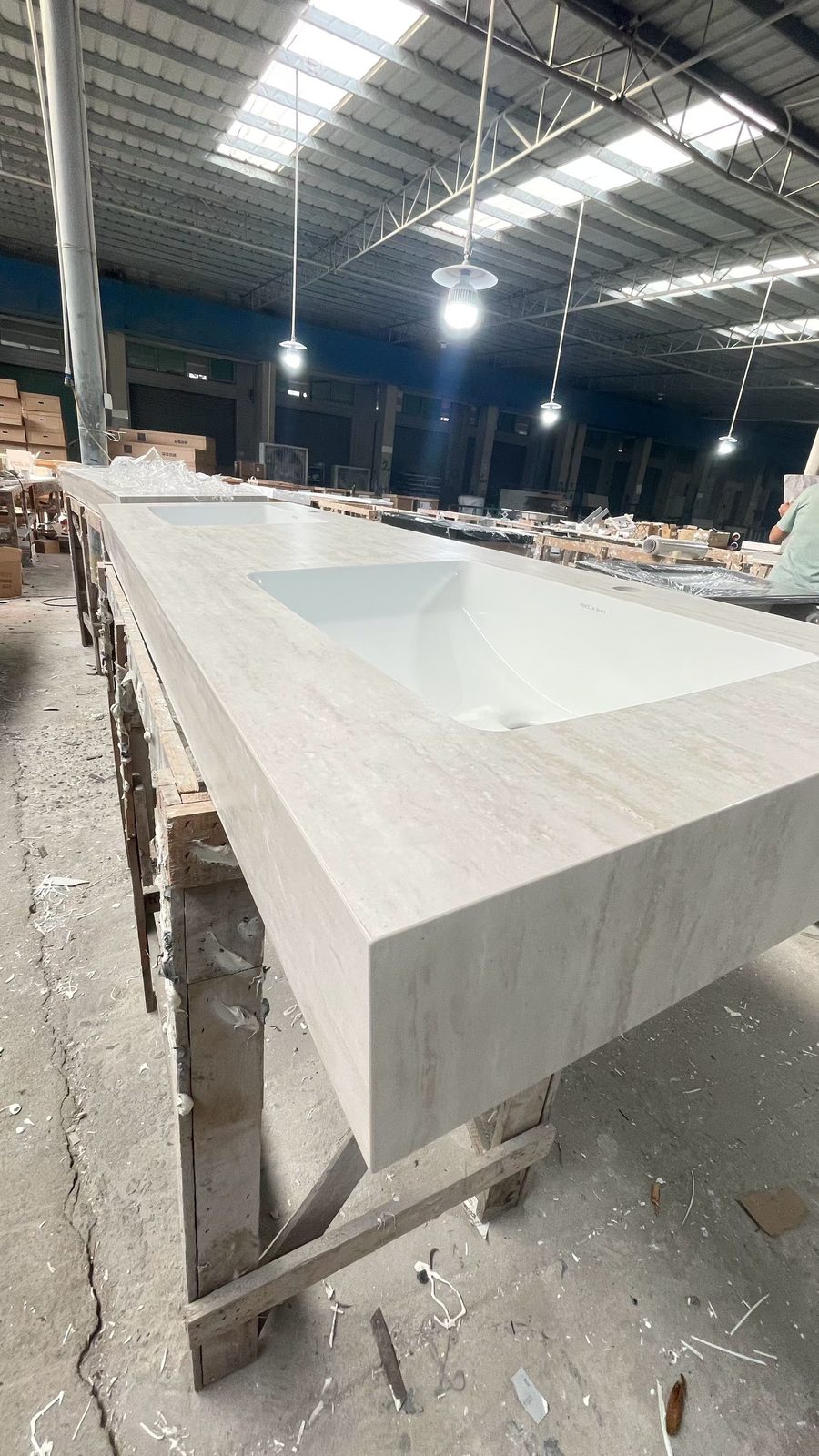
1. Edges chip. Hunker states it plainly in their sintered stone writeup: the material is “prone to chipping and cracking along the edges,” and repairs, they note, tend to be on the more expensive side. A Malaysian sintered stone distributor explains the mechanism: “A sharp, concentrated impact… can cause the surface to chip or even crack… polishing out damage removes the design layer and exposes the white body colour beneath” (sinnostone.com.my). Sharp corners are the vulnerable geometry. This is also where hot-bent construction helps: a single bent curve has no sharp glued corners, and the long front edge of a one-piece top is the most exposed line to protect during installation — keep bump guards on through the rest of the renovation.
2. The installer decides the outcome. The most-quoted buyer line on this topic comes from a Reddit owner (via content.mysterysmania.com, 2025-03-08): “Sintered stone can be durable but you have to find a very experienced installer otherwise you may have problems down the road.” The mechanism is well documented: uneven or incomplete support opens hairline cracks around cutouts, corners, and seams. A rigid one-piece top must sit level across its full footprint — if it rocks, level the cabinet first; the stone must sit flat across its full footprint. You need an experienced installer. Dry-fit before sealant, confirm drain-hole sizing at order time, and never overtighten the locknut on a pop-up drain.
3. Deep damage resists invisible repair. The stone-restoration trade’s own manual states the rule directly: “If it scratches, chips, or dulls, repairs can be limited. In many cases, surface damage is permanent, or it requires factory-level equipment to restore.” (sr-manual.com) Small shallow chips at an exposed edge can sometimes be rounded and re-polished — a working fabricator describes easing a tiny chip into a soft radius — but that technique succeeds by reshaping the corner; the original pattern stays gone. Deep chips in a patterned field stay visible. Buyers planning rental or hotel programs should price that in: prevention — foam, wooden crate, careful handling — beats every repair option.
Durability scorecard: where it stands
| Dimension | Verdict | Basis |
|---|---|---|
| Stain resistance | Strong | 0.07% water absorption, single-sample commission test, not product certification (G23-WT10751E) |
| Daily scratch resistance | Good | Hard mineral body; Barcol 89 on commissioned sample; matte finishes hide micro-marks |
| Heat (65°C, 60 min) | Verified | No cracking or discoloration, single-sample commission test, not product certification |
| Heat (boiling / thermal shock) | Unverified | Outside the tested range — no claim made |
| Edge impact | Vulnerable | Named limitation by Hunker and a sintered stone distributor |
| Installation tolerance | Low | Uneven support opens cracks; experienced installer required |
| Deep-chip repairability | Limited | Restoration trade manual: often requires factory-level equipment |
| Cleaning maintenance | Minimal | Non-porous, no sealing, mild soap and water |
| UV exposure | No yellow risk | No resin binder in the body to yellow — general material property |
What protects durability before and after delivery
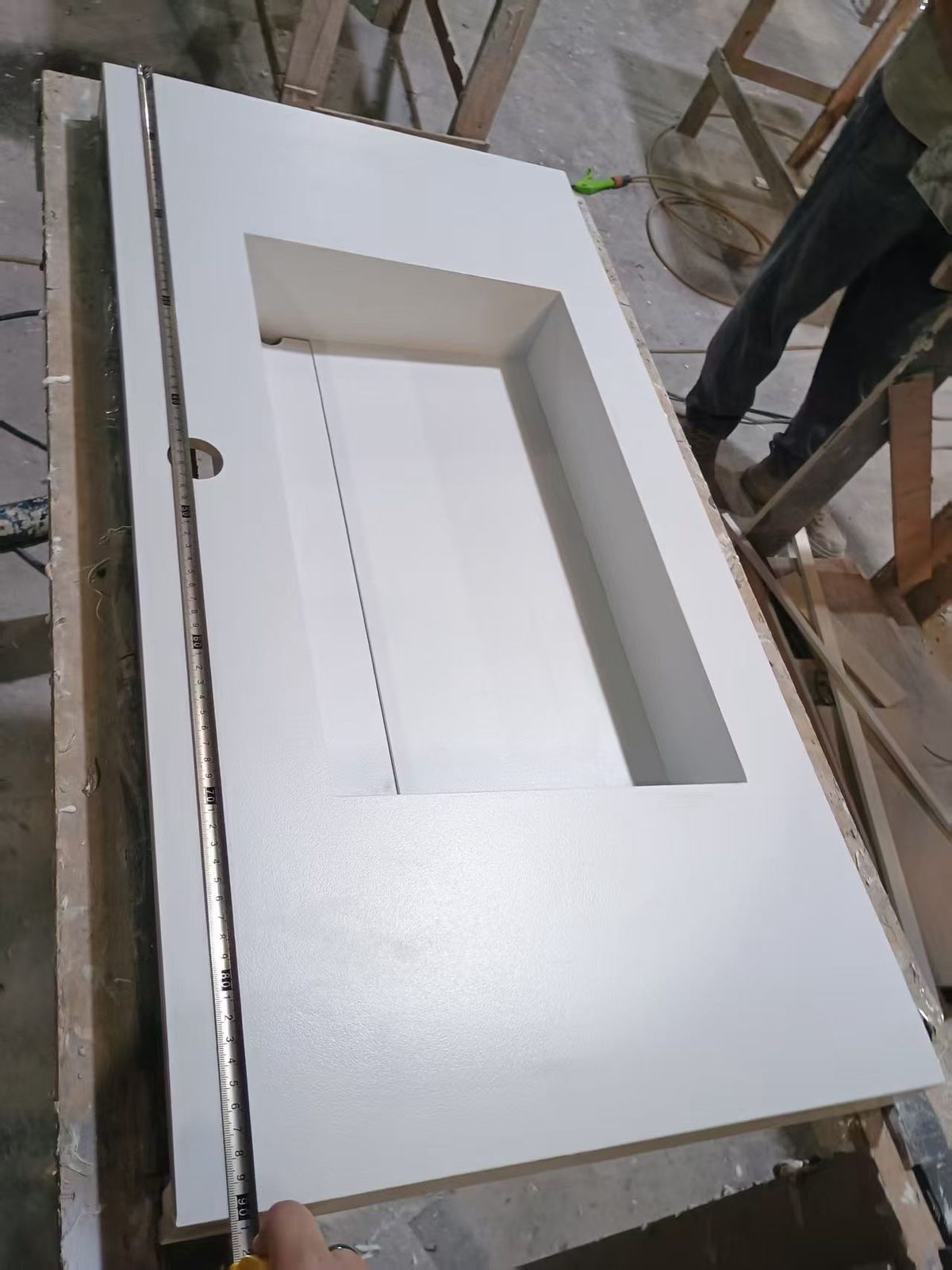
Three links in the chain sit on the factory side. Every basin top is measured against its spec before packing (the photo above is that step), then wrapped in protective foam and shipped in a wooden crate with internal framing and strapping — transit is the most common damage scenario, and the only real fix happens before the crate is sealed. Basins leave the factory with tap holes pre-drilled to mainstream mixer tap specs, which removes one on-site cut and one chance for a botched cutout.
The rest is the buyer’s side of the chain: a level cabinet, a competent installer, and gentle treatment of the edges during the remaining renovation. Durability comes from the slab, the support, and the installer together. Any supplier that sells you the slab without mentioning the other two is selling you half the story.
FAQ
Are sintered stone basins durable? A commissioned third-party test (G23-WT10751E, JC/T 2116-2012) on a single sample found 0.07% water absorption, 1.1 kN static load with no damage, and 65°C hot-water spray for 60 minutes with no cracking or discoloration — but this was a single-sample commission test, not product certification. The honest caveats: exposed edges can chip, repairs on deep chips are limited, and a skilled installer matters. Details are in the body of this guide.
Do sintered stone basins scratch easily? They resist scratches well in daily bathroom use. The 2023 commissioned lab sample recorded a Barcol hardness of 89 — a single-sample commission test, not product certification. Matte finishes hide micro-scratches better than polished ones. The caveat: once a patterned surface is deeply scratched, refinishing removes the printed design layer and exposes the white body beneath, so on patterned finishes, scratch removal has hard limits.
Will a white sintered stone basin stain? It resists staining well because the fused mineral body absorbs almost nothing. The commissioned sample measured 0.07% water absorption in a single-sample commission test, not product certification, which explains why coffee, toothpaste, and soap marks sit on the surface and wipe off. The honest exception is strong dye: hair color left for hours can tint a light-colored basin. Rinse pigments promptly.
Can a sintered stone basin handle boiling water? The only verified heat data we publish is the commissioned lab test: 65°C hot-water spray for 60 minutes with no cracking or discoloration on the single tested sample, a single-sample commission test, not product certification. That is well above normal tap temperature, but boiling water and thermal shock from ice-cold to boiling fall outside that tested range, so no verified claim covers them. The material’s resistance runs through the full thickness of the slab — the structural reason heat behavior is uniform — but the test data stops at 65°C.
What is the weakest point of a sintered stone basin? The edges. A Malaysian distributor describes it directly: a sharp, concentrated impact can cause the surface to chip or crack, and polishing out damage removes the design layer, exposing the white body beneath. The second weak point is installation: a Reddit owner’s warning has become the most-quoted line on this topic — durable, but only with a very experienced installer. The third is repair: the stone-restoration trade’s manual states that if sintered stone scratches, chips, or dulls, repairs can be limited, in many cases permanent or requiring factory-level equipment.
Get the durability story for your exact specification
Test data describes one sample; your order deserves its own conversation. To compare basin styles and finishes, browse the basin range, explore configurations in the configurator, or send an inquiry with your widths and finish preferences.
Inquiries go to our Foshan sales team and are used only for this inquiry — no mailing list, no group sends. Reply is from a person, not an automated funnel.
Specifications verified against Vora Surfaces factory records. Editorial review applied. Spotted an error? Email corrections to vorasurfaces@gmail.com.
Frequently asked questions
Are sintered stone basins durable?
A commissioned third-party test (G23-WT10751E, JC/T 2116-2012) on a single sample found 0.07% water absorption, 1.1 kN static load with no damage, and 65°C hot-water spray for 60 minutes with no cracking or discoloration — but this was a single-sample commission test, not product certification. The honest caveats: exposed edges can chip, repairs on deep chips are limited, and a skilled installer matters. Details are in the body of this guide.
Do sintered stone basins scratch easily?
They resist scratches well in daily bathroom use. The 2023 commissioned lab sample recorded a Barcol hardness of 89 — a single-sample commission test, not product certification. Matte finishes hide micro-scratches better than polished ones. The caveat: once a patterned surface is deeply scratched, refinishing removes the printed design layer and exposes the white body beneath, so on patterned finishes, scratch removal has hard limits.
Will a white sintered stone basin stain?
It resists staining well because the fused mineral body absorbs almost nothing. The commissioned sample measured 0.07% water absorption in a single-sample commission test, not product certification, which explains why coffee, toothpaste, and soap marks sit on the surface and wipe off. The honest exception is strong dye: hair color left for hours can tint a light-colored basin. Rinse pigments promptly.
Can a sintered stone basin handle boiling water?
The only verified heat data we publish is the commissioned lab test: 65°C hot-water spray for 60 minutes with no cracking or discoloration on the single tested sample, a single-sample commission test, not product certification. That is well above normal tap temperature, but boiling water and thermal shock from ice-cold to boiling fall outside that tested range, so no verified claim covers them. The material's resistance runs through the full thickness of the slab — the structural reason heat behavior is uniform — but the test data stops at 65°C.
What is the weakest point of a sintered stone basin?
The edges. A Malaysian distributor describes it directly: a sharp, concentrated impact can cause the surface to chip or crack, and polishing out damage removes the design layer, exposing the white body beneath. The second weak point is installation: a Reddit owner's warning has become the most-quoted line on this topic — durable, but only with a very experienced installer. The third is repair: the stone-restoration trade's manual states that if sintered stone scratches, chips, or dulls, repairs can be limited, in many cases permanent or requiring factory-level equipment.
Sourcing hot-bent basins for your next project?
Send your drawings and target quantities — we'll confirm feasibility from the factory floor.
Configure your inquirySee the products behind these guides: production cabinet styles and buying terms for buyers & OEM.
Specifications verified against Vora Surfaces factory records. Editorial review applied. Spotted an error? Email corrections to vorasurfaces@gmail.com.