
Factory guide
Fluted Bathroom Vanities: Trend or Timeless?
Fluted doors are drawing more buyer searches every season — search interest in the style on Wayfair and Amazon keeps climbing — but they cost extra cleaning time every week. This guide explains what reeded fronts actually are, how to judge groove quality before you order, and when solid wood flutes are worth the money over wrapped ones. No sales pitch; just what to check.
By Vora Surfaces Factory Editorial Team · Published 2026-10-07 · Foshan, China
What “fluted” means on a vanity
A fluted bathroom vanity has vertical grooves — called flutes, reeds, or tambour lines — milled or molded into the cabinet doors and drawer fronts. Stand in front of one and the surface reads as a series of slim vertical ribs, each catching light and shadow as you move. That play of light is the whole point: in a small bathroom, texture does the work that color can’t, because walls are usually white tile and there is nowhere else for the eye to go.
The technique itself is ancient. Cabinetmakers cut flutes into wood furniture centuries before anyone called it a trend, which is why a reeded front can sit comfortably in a farmhouse, a Japandi, or a contemporary bathroom without looking costume-y. What changed recently is scale: CNC routing made the pattern repeatable at volume, so it moved from custom joinery into the catalogue mainstream. Search interest on Wayfair and Amazon has climbed accordingly — buyers are looking for the word, and factories are tooling for it.
If you are pairing the style with a vanity unit, one rule helps: fluted doors have a lot going on, so the basin on top should be calm. A smooth, one-piece integrated basin balances the texture below. Riga, our 2026 new concept design, tests exactly this pairing — deep walnut flutes on the cabinet with a white hot-bent integrated basin on top. (It is a concept, not a production model — treat the photos as a design direction.)
The cleaning question, answered honestly
Every article about fluted fronts praises the texture. Almost none talk about the dust. Let’s fix that.
Grooves collect what flat doors shed: dust, hairspray mist, toothpaste flecks. Wiping a fluted door means running the cloth down each channel, rather than one sweep across a panel. If you clean weekly, the difference is a couple of minutes. If you clean monthly, the grooves tell the story — buildup in the channels shows before it does on a flat front, especially in darker finishes.
This is a genuine trade-off: shallow grooves are a design choice with a maintenance cost. Shallow, softly rounded flutes are much easier to keep clean than deep, knife-sharp ones — a damp cloth reaches the bottom of the groove in one pass, with no tight corner for grime to sit in. If maintenance ease is your number-one priority, flat fronts are simply the better buy. Nobody should talk you out of that.
A practical middle path: reserve fluted fronts for the vanity — one cabinet you actually look at — and keep the rest of the bathroom flat. You get the texture where it matters and halve the cleaning surface.
Solid wood flutes vs wrapped flutes
There are two ways to make a fluted door, and they behave very differently in a bathroom.
A solid wood fluted door has the grooves milled directly into the wood — on a CNC router, into cabinet bodies that are already moisture-proof treated. A nick or stain can be sanded and refinished, and there is no glued-on layer around the grooves to lift in steamy air.
A wrapped fluted door starts as MDF or particleboard, then a film or veneer is pressed into the grooves to make it look like fluted wood. The weak point is where you’d expect: the groove edges. Film has to stretch into every channel, and in a humid bathroom those edges are the first place it lifts and peels. Once a wrap lifts in a groove, it cannot be glued back invisibly — the door needs replacing.
| Solid wood flutes | Wrapped flutes | |
|---|---|---|
| How flutes are made | Milled into the wood (CNC) | Film/veneer pressed over a board |
| Humidity resistance | Good — moisture-proof solid wood, no layers to lift | Weak point — wrap lifts at groove edges in steam |
| Damage repair | Sand and refinish | Not repairable — replace the door |
| Cost | Higher | Lower |
| How to verify | Ask for a close-up of the groove ends; solid wood shows grain | Ask what the substrate is under the wrap |
The cost gap is real, so this isn’t a “buy solid wood or else” rule. A wrapped fluted door can work in a powder room or a rarely-steamed guest bath. For the main bathroom — the one that runs a hot shower twice a day — solid wood flutes are the safer money.
This is also where our cabinet-material guide helps: if you want the full picture on what sits behind the doors, read the solid wood bathroom vanity buying guide before you sign anything.
The five-point fluted buying checklist
Run these five checks before you order a fluted vanity, from any supplier. They take one email thread and they catch most problems.
1. Groove geometry. Ask for a macro close-up of the flutes. Rounded inner corners beat sharp V-shapes — the rounded ones wipe clean, the sharp ones trap grime. Grooves should read as texture from across the room but stay shallow enough for a cloth to reach the bottom.
2. Flute construction. Solid wood with CNC-milled flutes, or board with wrapped flutes? Get it in writing, including the substrate under any wrap. This one question splits the market cleanly.
3. Edge and end sealing. On wrapped doors, ask how the groove edges and the door’s top and bottom edges are sealed against moisture. On solid wood, ask about the moisture-proof treatment of the cabinet body — it keeps the whole unit stable in a wet room.
4. Groove consistency across doors. On a two-door vanity, the flute pattern should continue from one door to the next — misaligned channels are the telltale sign of cheap production. Ask for a photo of the full front, rather than a single door detail.
5. Hardware and basin fit. Texture gets the attention; the parts that fail are the same as on any vanity. Hinges and drawer slides should be a recognized grade (Kubo or DTC, or equivalent-grade), doors should close on soft-close hinges, and the basin top should arrive with tap holes pre-drilled to your mixer spec. On our floor, every basin top gets a tape-measure check against the order spec before packing — ask any supplier what their before-packing check looks like.
Packing matters more than buyers expect: a fluted door’s ridges chip if the crate allows movement, so units should travel foam-wrapped in wooden crates with internal framing.
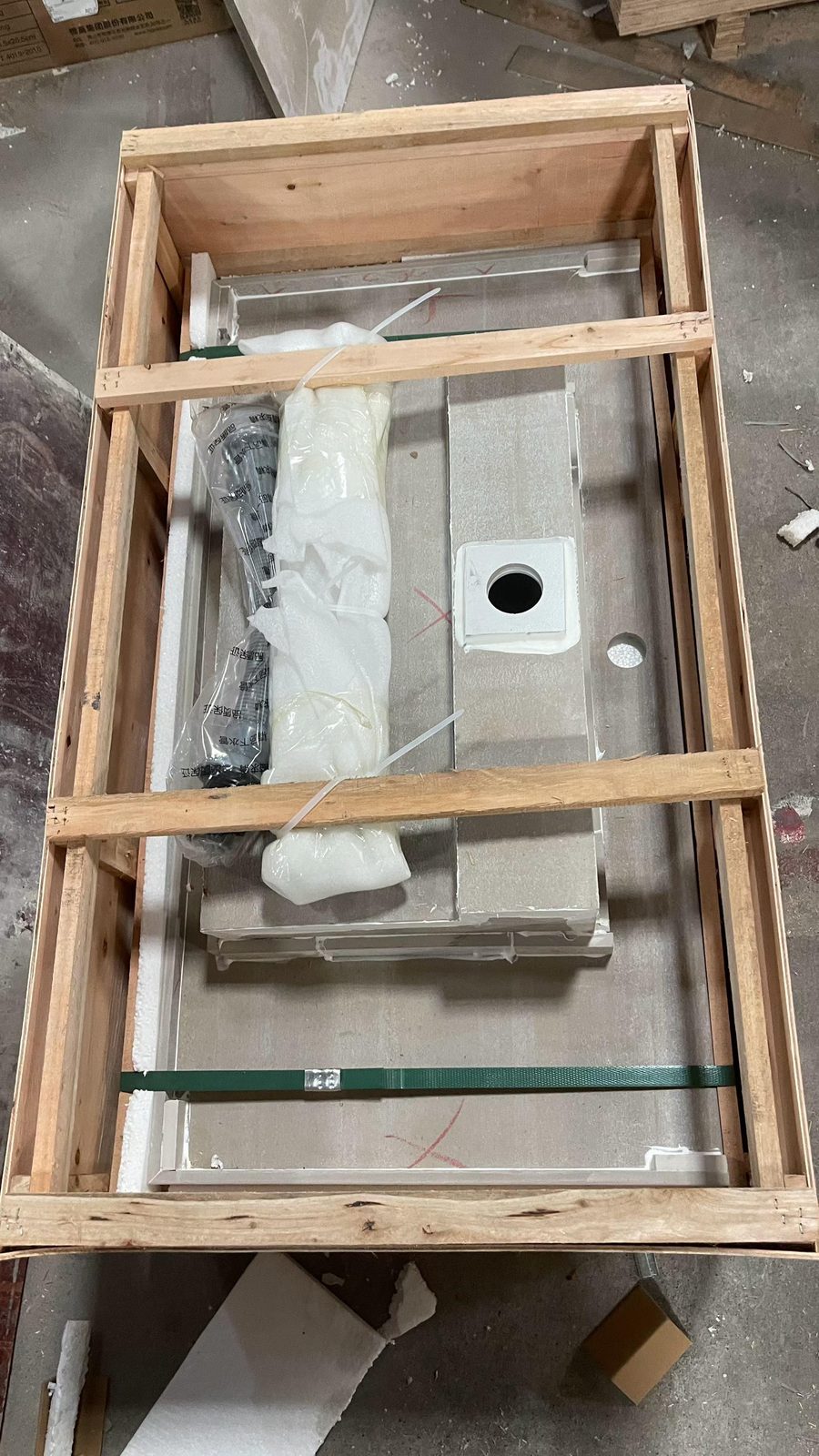 Foam wrap and a framed wooden crate protect ridged door fronts on the way out — thin cartons don’t.
You can see how a factory pack handles this — foam wrap, framed wooden crate, strapping, then the tape check before the crate closes.
Trend or timeless?
The fluted door front is a trend — it will peak, and in ten years flat fronts will have their turn again. But the cabinet behind it doesn’t have to be. A moisture-proof solid wood body, good hardware, and a seamless integrated basin are simply solid construction, trend or no trend. Put a fluted front on a well-built cabinet and you get the texture you want now, on a body you can refit later. Put a fluted front on a bad cabinet and you’ve bought the trend with none of the staying power.
That’s why the pairing matters: a white hot-bent basin on top — one continuous piece, no glued seams — gives the eye a quiet place to rest. Without that calm element, fluted fronts tip into fussiness.
Browse the vanity collection to see how integrated basins sit on different cabinet bodies, and pick the finish you could live with for a decade — because the texture you love in 2026 still needs to look right in 2032.
Frequently asked questions
Are fluted bathroom vanities just a passing trend? They are a strong trend — search interest in reeded fronts on Wayfair and Amazon keeps climbing. But the look is old: fluted woodwork goes back centuries, so it should age better than the last flat-front fad. Treat it as a fashionable finish on a classic structure.
Is a solid wood fluted vanity better than a wrapped one? Usually, yes. The flutes on a solid wood door are milled into the wood itself, so there is no edge to peel — and solid wood can be refinished. On a wrapped door, the film has to bend into every groove, and those edges are the first place it lifts in a steamy bathroom. The trade-off is cost.
Are fluted bathroom vanity doors hard to clean? They take more effort than flat fronts — that is the real cost of the texture. Dust settles into the grooves, and wiping takes a few more passes. Shallow, rounded flutes clean far more easily than deep, sharp ones. If easy maintenance is your top priority, flat doors are the better choice.
What groove depth should I look for on a fluted vanity? A practical rule: the flutes should read as texture from across the room, but stay shallow enough that a damp cloth reaches the bottom of each groove in one pass. Ask for a close-up photo — sharp inner corners trap grime, softly rounded ones wipe clean.
Does a fluted vanity work with an integrated basin? It is a natural pairing. The busy texture sits on the doors below, and a smooth, one-piece integrated basin on top gives the eye a quiet place to rest. Factories that hot-bend their basins in-house can also pre-drill tap holes to your faucet spec.
Frequently asked questions
Are fluted bathroom vanities just a passing trend?
They are a strong trend right now — search interest in reeded fronts on Wayfair and Amazon keeps climbing. But the look is old: fluted woodwork goes back centuries, so it should age better than the last flat-front fad. Treat it as a fashionable finish on a classic structure, and pick a cabinet body you would keep even if the cycle moves on.
Is a solid wood fluted vanity better than a wrapped one?
Usually, yes. The flutes on a solid wood door are milled into the wood itself, so there is no edge to peel — and solid wood can be refinished. On a wrapped door, the film has to bend into every groove, and the groove edges are the first place it lifts in a steamy bathroom. The trade-off is cost: solid wood fluted fronts are the more expensive build.
Are fluted bathroom vanity doors hard to clean?
They take more effort than flat fronts — that is the real cost of the texture. Dust and toothpaste settle into the grooves, and wiping takes a few more passes. Shallow, rounded flutes clean far more easily than deep, sharp ones. If easy maintenance is your top priority, flat doors are the better choice and no one should talk you out of them.
What groove depth should I look for on a fluted vanity?
A practical rule: the flutes should read as texture from across the room, but stay shallow enough that a damp cloth reaches the bottom of each groove in one pass. Ask the supplier for a close-up photo of the flutes — sharp inner corners trap grime, softly rounded ones wipe clean.
Does a fluted vanity work with an integrated basin?
It is a natural pairing. The busy texture sits on the doors below, and a smooth, one-piece integrated basin on top gives the eye a quiet place to rest. Factories that hot-bend their basins in-house can also pre-drill tap holes to your faucet spec.
Sourcing hot-bent basins for your next project?
Send your drawings and target quantities — we'll confirm feasibility from the factory floor.
Configure your inquirySee the products behind these guides: production cabinet styles and buying terms for buyers & OEM.
Specifications verified against Vora Surfaces factory records. Editorial review applied. Spotted an error? Email corrections to vorasurfaces@gmail.com.