
Factory guide
Solid Wood Bathroom Vanity: What to Check Before You Buy
A solid wood bathroom vanity can serve for decades or fail within a few years — and the wood itself is rarely the deciding factor. What decides it is the moisture-proof treatment, the joinery, and the hardware grade. This guide compares cabinet materials honestly, gives you five checks to run before you order, and a short inspection list for delivery day.
By Vora Surfaces Factory Editorial Team · Published 2026-10-07 · Foshan, China
The uncomfortable truth about wood in bathrooms
Solid wood has an excellent reputation, and in a bathroom it is partly deserved: a dense, well-finished timber board shrugs off humidity that destroys cheaper boards. But here is the part sellers skip. Good timber with a careless moisture-proof treatment is a slow disaster. Steam from the shower finds every untreated cut edge, every drilled hole, every gap in the finish — and once water gets under the coating, solid wood swells, joints open, and the beautiful cabinet you paid for starts telling on its maker.
That is why “Solid wood” on a spec sheet answers one question and opens several more. The questions that matter are dull ones: which parts are actually solid, what exactly was treated, how are the edges sealed, and what holds the drawers. This guide walks through all of them.
Solid wood vs particleboard vs plywood/MDF
Most bathroom vanity cabinets are built from one of four materials. The table below compares how each behaves when moisture reaches it, how to identify it, and where it typically fails in a bathroom.
| Solid wood | Particleboard | Plywood / MDF | |
|---|---|---|---|
| What it is | Boards cut from timber; the grain runs through the whole piece | Wood chips pressed together with resin | Plywood: thin veneer layers glued crosswise. MDF: fine wood fibers pressed into a dense, uniform board |
| When water gets in | Swells locally around the entry point; mostly recovers when dried, though a long soak can warp it | Swells fast and crumbles; does not recover its shape once the core is wet | Plywood resists better than particleboard when the glue is moisture-rated. MDF swells at any unsealed edge and stays swollen |
| How to spot it | Continuous grain on the face, visible end grain on cut edges | Pressed chips visible on any raw edge; the edge crumbles when scratched with a fingernail | Plywood shows layered stripes on cut edges; MDF edges are smooth and uniform with no grain at all |
| Typical bathroom failure | Finish cracks at a joint, moisture enters through the crack | Toe-kick and bottom shelf swell first — the parts closest to floor water | Unsealed cut edges around plumbing holes swell; screws and hinges tear out of soft MDF |
Two things the table makes clear. First, every material has a failure mode — the question is always what protects it. Second, particleboard fails earliest and ugliest in wet zones, which is why it deserves the hardest questions. A cabinet that hides particleboard behind a “wood vanity” label is a common source of buyer disappointment.
Five checks before you order
1. Ask which parts are solid wood, and how they are joined
“Solid wood vanity” is a phrase with a wide legal range. In many cabinets it means a solid wood frame with MDF or plywood panels, or solid doors on a particleboard carcass. None of that is automatically bad — but you should know exactly what you are buying. Ask for it per component: carcass, doors, drawer fronts, drawer boxes, back panel. Get the answer in writing.
Then ask about joinery. Drawer boxes joined with dovetails or dowels stay square for years; boxes held by staples loosen with daily use. Doors on proper hinges with adjustment screws stay aligned; doors on fixed cheap hinges sag. The carcass joints — dowel, mortise-and-tenon, or simple butt joints with screws — tell you how the box will behave when the bathroom humidity swings between seasons.
2. Ask what “moisture-proof treatment” actually covers
This check deserves extra attention, and it is the one most buyers skip. A moisture-proof treatment is only as good as its coverage. Ask whether all six sides of every board are treated, or only the faces you can see. Ask how cut edges, drilled plumbing holes, and the cabinet underside are sealed — those hidden surfaces are exactly where steam and splashes attack. Ask what the finish coating is and whether the interior gets the same treatment as the exterior.
Listen to the specificity of the answer. A maker who can tell you which surfaces are sealed and how the edges are finished has a real process. A seller who answers “it’s waterproof” and moves on does not.
3. Check the hardware grade
In a humid room, hinges and drawer slides work harder than the wood does. Look for recognized hardware makers — Kubo and DTC are the standard reference grades in this industry, or hardware explicitly stated as equivalent grade. Confirm the drawers run on full-extension slides and the doors close on soft-close hinges. Then test: open and close every door and drawer several times under normal load, and feel for grinding, sticking, or sideways play.
Pay attention to the metal itself. Hinges and screws are usually the first parts to rust in a bathroom, long before the wood shows trouble. Ask how the metal parts are protected against corrosion, and check that hinge plates have enough adjustment range to keep doors aligned after the cabinet settles.
4. Inspect the finish and the edge banding
The finish is the cabinet’s raincoat, and raincoats fail at the seams. Look at the coating under good light across every face, including the underside and the back — thin spots and holidays in the coating show up as dull patches. Run a finger along every edge: edge banding should sit flush with no lifted corners, no gaps, and no sharp overhang. Corners and joints deserve a close look, because a hairline crack at a joint is a future water entry.
If the cabinet has a painted finish, check inside the drawers and behind the doors too. Interiors that were skipped to save cost will tell you within a year.
5. Match the basin to the cabinet — and confirm the faucet holes
Basin and cabinet have to fit each other, so buy them as one system. A one-piece hot-bent basin — basin and countertop formed from a single slab with no seam — removes the caulk line where water usually collects, but it also means the basin arrives exactly as the mold made it. Confirm the basin’s outer dimensions against the cabinet top, and confirm the faucet-hole positions against your faucet’s spec sheet before anything ships.
Ask whether faucet holes are pre-drilled at the factory to standard specifications, and at what point the hole diameter gets locked in — on our line the diameter is confirmed at the order stage, so the faucet you planned is the faucet that fits. A basin that arrives with holes in the wrong place has to be replaced.
If you are pairing the cabinet with a mirror, settle that at the same time. LED touch mirrors with optional anti-fog are a common pairing with solid wood vanities, and the wiring plan is easier to confirm before the cabinet leaves the factory than after it is mounted on your wall.
Delivery-day inspection
The factory’s job ends at the loading dock; yours begins at the curb. Work through this list before you sign the delivery receipt.
| Check | What to do |
|---|---|
| Crate and wrapping | The unit should arrive wrapped in protective foam inside a wooden crate with internal framing and strapping. Photograph any visible crate damage before opening — that photo is your evidence if something inside is broken |
| Dimensions | Measure the finished unit with a tape measure and compare it against your order. A careful factory runs this exact tape check before packing, so your measurement should match |
| Faucet holes | Compare hole positions and diameter with your faucet’s spec sheet |
| Hardware | Open and close every door and drawer. Hinges should adjust cleanly, slides should run full extension without grinding |
| Finish | Check all faces, edges, and the underside under good light for chips, thin spots, and banding gaps |
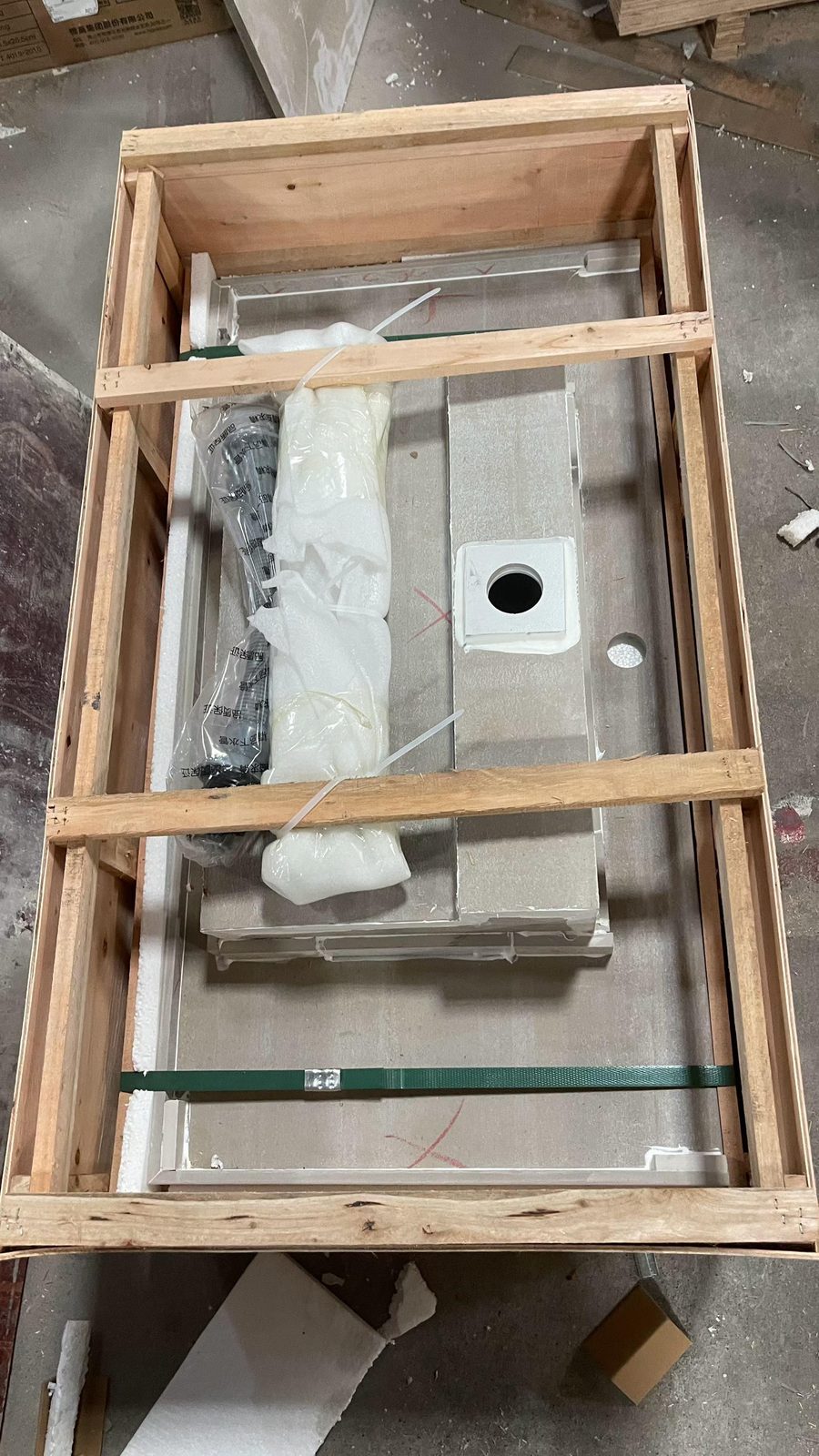
Refuse a delivery only when the damage is structural; for a chipped edge or a scuffed panel, photograph everything and contact the seller the same day. Small finish damage caught on day one is a warranty conversation. The same damage discovered after installation is an argument.
What we make, stated plainly
At Vora Surfaces, our cabinet bodies are solid wood with moisture-proof treatment, and every basin is hot-bent in-house at our Foshan factory — the bending is never outsourced. Hardware is Kubo/DTC or equivalent grade, mirrors are LED touch with optional anti-fog, and basins leave the factory with standard-spec faucet holes pre-drilled, the diameter confirmed at the order stage. The catalogue runs about 40 models in the common 60–120 cm widths, and extra-wide 72”+ double-basin configurations are supported as custom orders. If you are still comparing profiles, browse the cabinet range or the hot-bent basin hub to see what the standard models look like, and the wholesale sourcing guide covers the factory-verification questions worth asking any supplier — including us.
Frequently asked questions
How can I tell whether a vanity cabinet is really solid wood?
Look at a raw or cut edge: solid wood shows continuous grain running through the material and visible end grain, while particleboard shows pressed chips and MDF shows a uniform fiber mat. Ask the seller which parts are solid — many cabinets sold as solid wood have a solid frame with MDF or plywood panels, so get the answer in writing per component: carcass, doors, drawer fronts, and drawer boxes.
Is solid wood better than plywood for a bathroom vanity?
Treatment decides more than the material label. Solid wood with full moisture-proof treatment and sealed edges handles bathroom humidity well, and plywood with good sealing and moisture-rated glue performs respectably too. Particleboard is the riskiest in wet zones because it swells and crumbles once water reaches the core. Judge the treatment details and the hardware grade — the material name on the spec sheet tells you less than what was done to protect it.
What should I ask about moisture-proof treatment before buying?
Ask exactly which surfaces are treated — all six sides of every board, or only the visible faces? Ask how cut edges, drilled holes, and the cabinet underside are sealed, since those are the entry points for steam and splashes. Ask what the finish coating is and whether the interior gets the same treatment as the exterior. Vague answers like 'it's waterproof' with no specifics are a red flag.
What hardware grade should a bathroom vanity have?
Look for recognized hinge and slide makers — Kubo and DTC are the common reference grades, or hardware stated as equivalent grade. Check that drawers run on full-extension slides and doors close on soft-close hinges, then open and close everything several times under normal load. In a humid room, hinges and screws are usually the first parts to rust, so ask how the metal parts are protected.
How do I inspect a vanity when it arrives?
Check the packaging first: the unit should arrive wrapped in protective foam inside a wooden crate with internal framing and strapping. Measure the finished dimensions with a tape measure and compare them to your order — a careful factory runs this tape check before packing. Confirm faucet-hole positions against your faucet spec, then open every drawer and door to test the hardware before signing off.
Sourcing hot-bent basins for your next project?
Send your drawings and target quantities — we'll confirm feasibility from the factory floor.
Configure your inquirySee the products behind these guides: production cabinet styles and buying terms for buyers & OEM.
Specifications verified against Vora Surfaces factory records. Editorial review applied. Spotted an error? Email corrections to vorasurfaces@gmail.com.