
Factory guide
Heat-Bent Sintered Stone Basins Wholesale: A Buyer's Sourcing Guide
A heat-bent sintered stone basin starts as a single slab, heated until pliable, then pressed into a mold — the basin and its curves come out as one continuous piece with no glued seams. In wholesale sourcing, the word only means something if the bending happens inside the supplier’s own factory. Traders relabel glued basins with the same term every day, and the listing copy will not tell you which one you are looking at.
This guide is a checklist for importers, distributors, and wholesalers buying in volume — written to be run against any supplier, including us. Every step is something a real factory answers in one message; every red flag is something we have seen traders do.
Why wholesalers get burned
The failure mode is almost always the same. A buyer finds a “factory” on a marketplace, the catalogue photos look right, the price undercuts the next quote by a margin that should raise questions, and the word “hot-bent” appears in the product title. The first container arrives with basins that have a faint line at every bend — glued miters. By the second order, the joint lines on installed units start yellowing. The buyer’s customers blame the buyer. The factory sits three time zones away, beyond their reach.
Marketplace storefronts dominate wholesale queries on domain authority, but many are trading companies renting factory photos. A high rank tells you nothing about who actually bends stone — your verification has to do that work.
The verification checklist
Run every candidate supplier through this table before you talk price. A real factory answers each row with evidence; a trader answers with adjectives.
| Verification item | How to check | Red flag |
|---|---|---|
| In-house bending | Ask for a short video of the bending step — the heated slab going into the mold. Finished-basin photos prove nothing. | Only showroom photos; “our partner factory handles bending” |
| Mold and tooling list | Ask which profiles and widths are already tooled, and what a new mold costs. | “Any size, any shape, no problem” — no factory says this |
| QC routine | Ask what gets measured before packing, and request QC photos from a recent batch. | “We check everything” with nothing to show |
| Packing standard | Ask for packing photos: foam wrap plus wooden crate with internal framing and strapping. | “Standard export packing,” no photos, thin cartons |
| Basin construction | Inspect the bend on a sample: a true hot-bent curve has no joint line. | Visible seam at the bend on a “hot-bent” listing |
| Custom track record | Ask for examples of past custom work — widths, finishes, tap-hole specs. | Catalogue-only; every custom request “needs manager approval” |
| After-sales policy | Ask who pays when a basin arrives cracked: replacement or repair? | “Repaired to 95%” offers; no written replacement policy |
Two of these rows deserve more detail, because they are where wholesale orders actually fail: packing and customization.
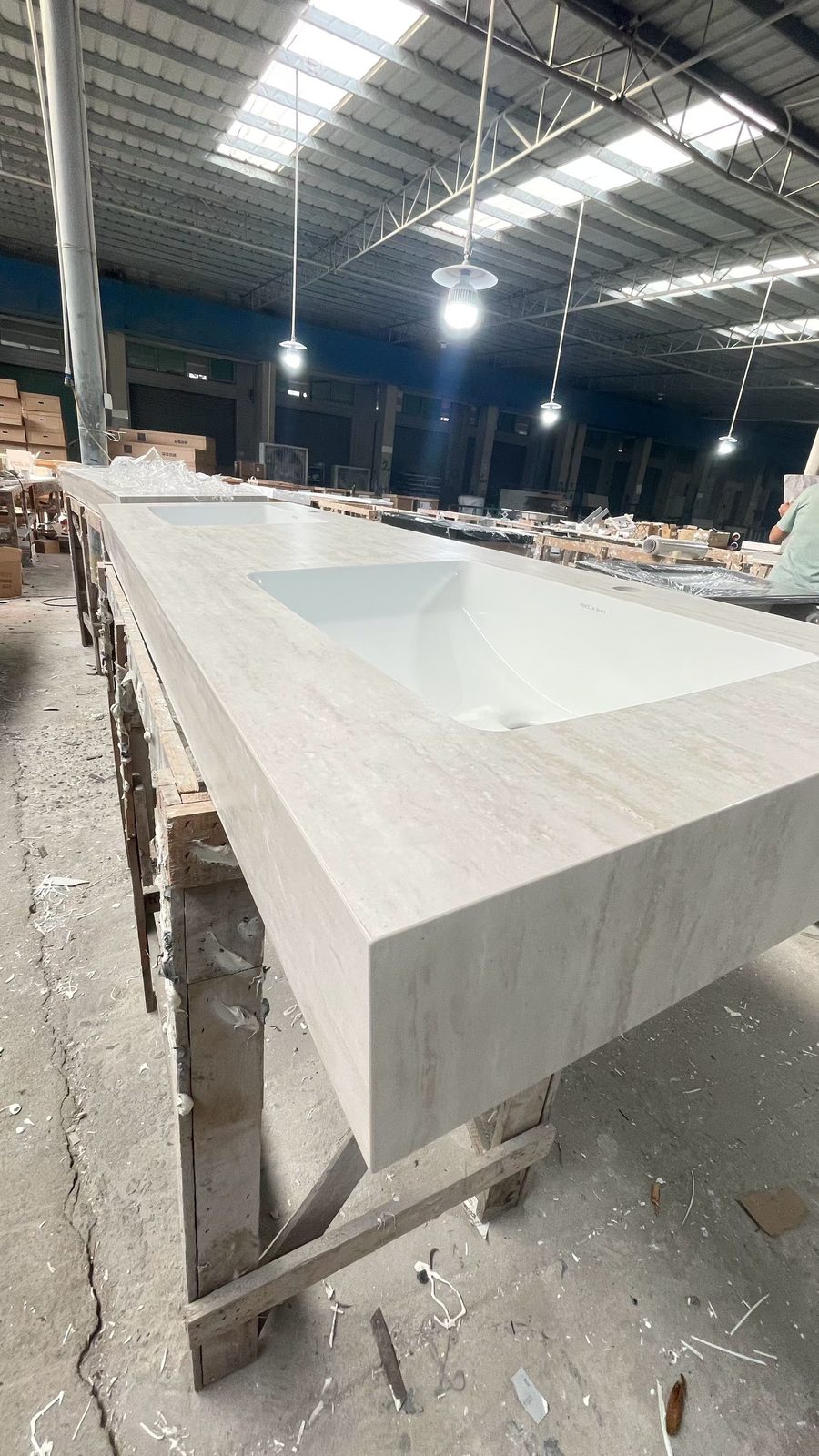 A long vanity top with integrated basin in production — one-piece forming before the finishing and packing stages.
QC: what to actually look at
Factory QC for stone basins is a short list of physical checks: It is a short list of physical checks, and you should ask which ones your supplier performs on every unit versus on a sampling basis.
The checks that matter: dimensional check of the basin top before packing (tape-measure against the order spec — the one we photograph), visual inspection of the bend radius for stress marks, tap-hole position and diameter against the agreed spec, and a final look-over after foam wrapping. Basins leave our floor pre-drilled for mainstream mixer tap specs, with hole sizing confirmed against your tap choice at order time.
Ask for QC photos from a real, recent batch. One photo of a tape measure across a basin top tells you more than a page of ISO claims. And note what is not on this list: we do not publish material performance numbers or process temperatures as marketing figures, and you should be skeptical of any supplier that does without naming the lab and the test standard.
Packing: the standard that prevents cracked arrivals
Cracked-on-arrival is a frequent wholesale dispute in this category. Amazon aggregate reviews put “damage upon arrival” at 6.8% of negative feedback for stone vanities, and buyer forums are full of two-cracks-in-a-row stories that stalled entire projects. The fix is unglamorous: packing spec, agreed in writing before the order ships.
The standard that works: each basin wrapped in protective foam, then crated in a wooden crate with internal wooden framing and strapping. That is the routine on our floor, and we photograph it because buyers who have been burned once always ask. Reject thin cartons, “standard export packing” with no photos, and any supplier who treats packing photos as an unusual request.
When a crack does happen despite good packing, the policy question matters more than the packing question. Buyers often reject “repaired to 95%” offers on cracked stone — a crack is structural damage — and the suppliers worth keeping replace the unit. Get the replacement policy in writing with the packing spec. Our guide to telling hot-bent from glued covers what to photograph before the crate is fully opened.
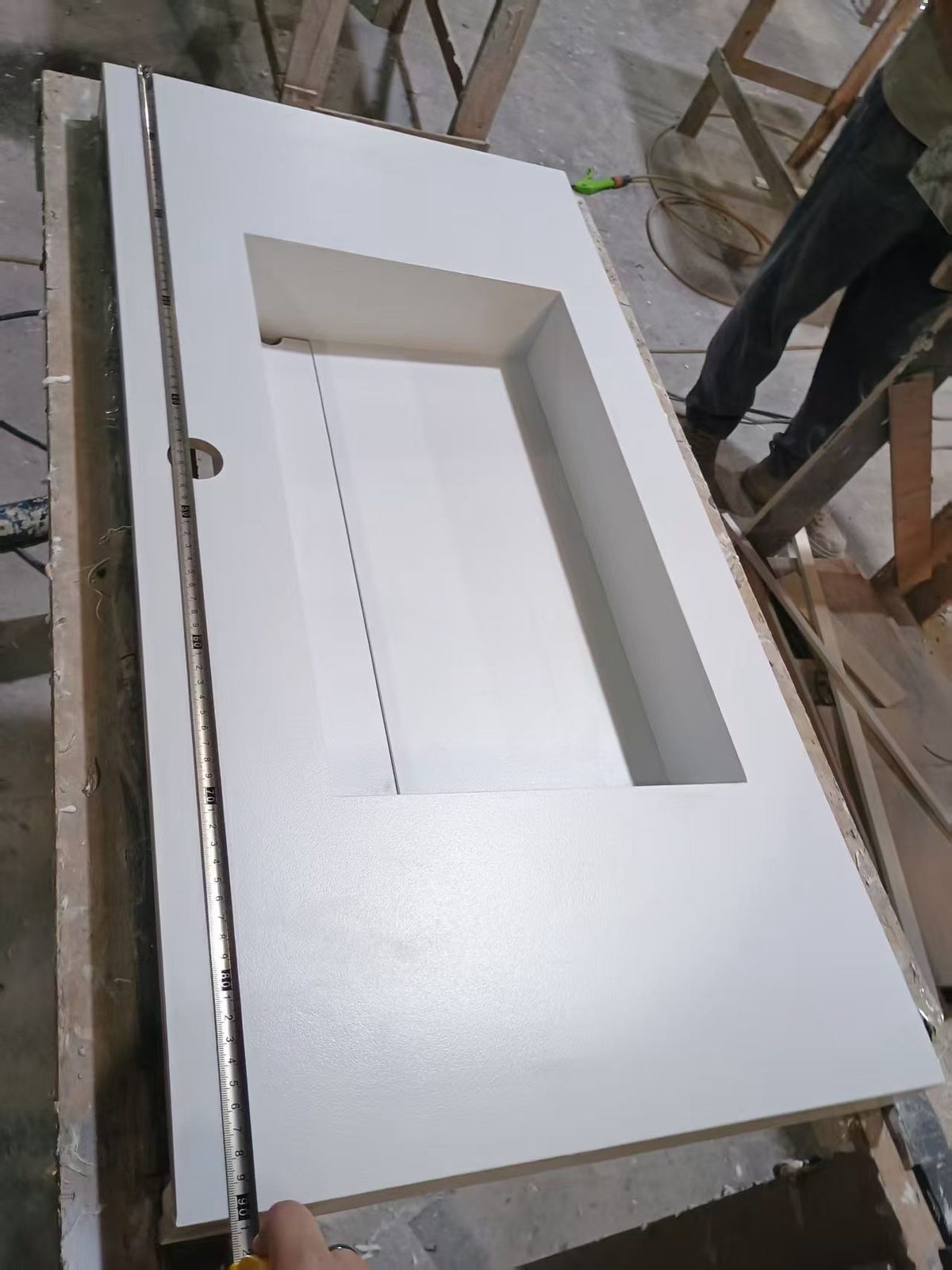 Dimensional check before packing: the basin top is tape-measured against the order spec on the factory floor.
Customization: how to talk about it
Wholesalers rarely buy catalogue-only for long. The conversation always moves to widths, finishes, and tap configurations — and this is where the mold economics of hot-bending shape what is possible.
The honest framing: hot-bending needs a steel mold per profile. Sizes and profiles already tooled are straightforward; new profiles add tooling cost and lead time. That constraint is also your verification tool — a supplier with a real mold list gives you straight answers about what exists and what a new mold costs, while a trader says yes to everything and figures it out later (usually by gluing).
What we can confirm from our floor: the catalogue runs about 40 models in the common 60–120 cm widths, and the factory builds the full hot-bent basin and vanity category beyond the catalogue — including extra-wide 72-inch-plus double-basin layouts, custom stone patterns and cabinet finishes, and tap holes cut to mainstream specs. What we will not do: quote one flat MOQ or price for “everything.” Both move with the model, finish, and quantity — get them in writing per SKU, and treat a price list that never changes with volume as a red flag.
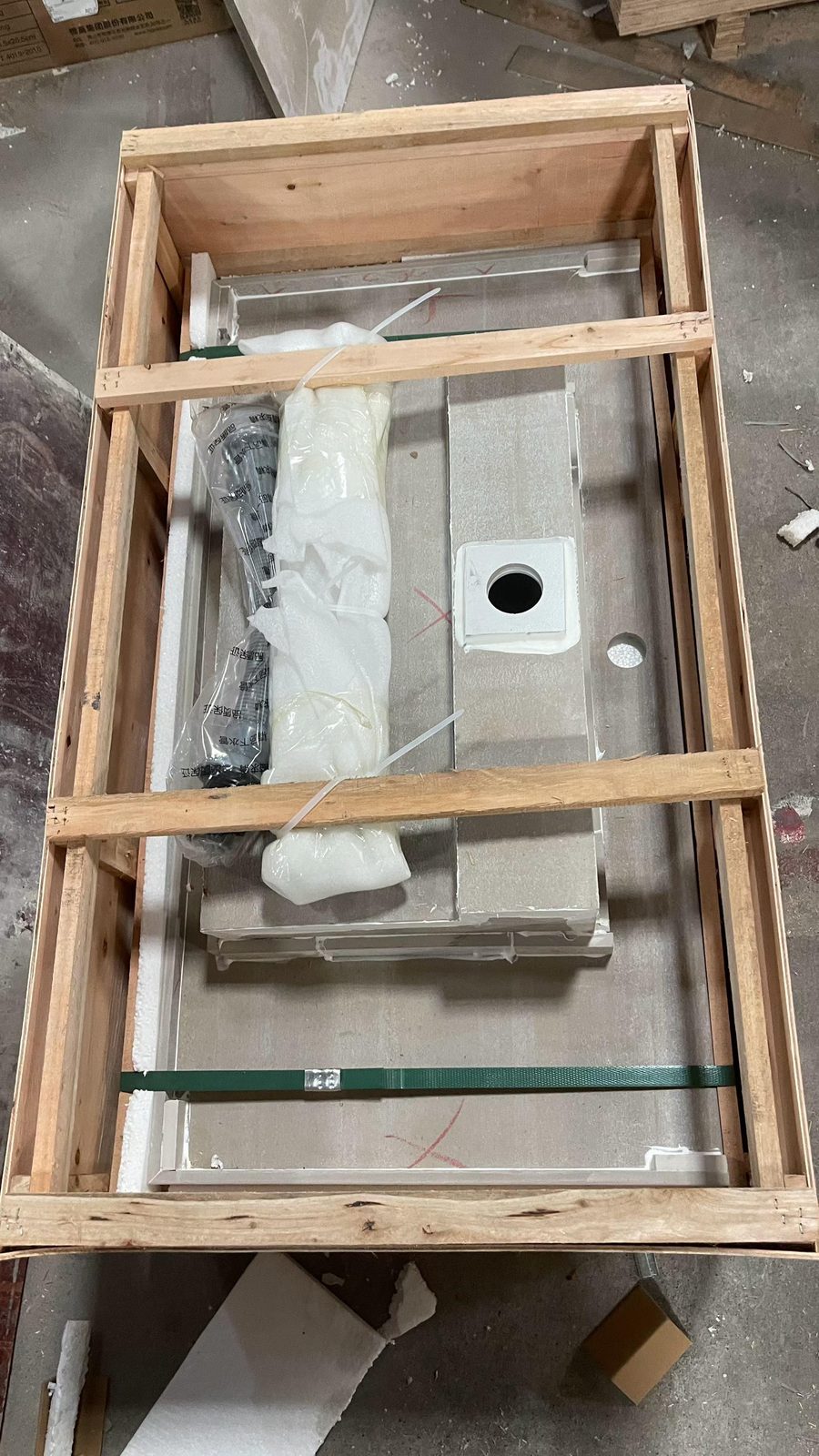 Foam-wrapped basin inside a wooden crate with internal framing and strapping — the packing standard to agree in writing.
Red flags, in one list
If you skimmed the table, here is the short version to keep on your phone during supplier calls:
- No video of the bending process exists. Ever.
- “Any size, any shape” with no mold list behind it.
- QC described only in adjectives, never in photos.
- Packing described as “standard” with nothing to show.
- A visible joint line at the bend on a “hot-bent” sample.
- One flat price and MOQ for the entire catalogue.
- “Repaired to 95%” as the cracked-arrival policy.
- The same catalogue photos appear under three different company names on marketplaces.
Any two of these together is enough to walk away. There are real factories in this category — the verification above finds them in one round of messages.
Honest limits: what hot-bending cannot do
A sourcing guide that only praises the process is a brochure. Here are the limits, stated plainly.
Not every shape is bendable. Hot-bending is constrained by mold feasibility: smooth curves, yes; sharp architectural folds and asymmetric geometry, no. A saw cuts any angle a mold cannot produce, which is why glued construction owns those designs. If your line needs sharp folds, buy glued from a good gluer — do not ask a bending factory to fake it. For which profiles the process handles well, see can sintered stone be bent.
Chips show the body. Sintered stone patterns are printed on the surface; a hard edge impact can chip through to the paler body beneath, and field repair options are limited. This is a material property shared by every supplier’s basins equally., and it applies to every supplier’s basins equally. Our repair guide covers what field repair can and cannot do — share it with your retail customers before they ask.
The premium needs a customer. Hot-bending costs more than gluing — the furnace time and the molds are real costs. It pays back where a failed joint would cost callbacks: hotels, premium residential, your own brand line. For price-driven tenders and fast-turnover rentals, glued wins on unit cost and no honest factory will tell you otherwise.
Frequently asked questions
How can I verify a supplier really hot-bends their basins in-house? Ask for a short video of the bending step itself — the heated slab going into the mold — plus a list of which profiles and widths are already tooled. A factory that bends in-house produces both in minutes; a trader reselling glued basins cannot. As a final check, look at the bend on a finished basin: a true hot-bent curve has no joint line.
What should wholesale packing for sintered stone basins include? Each basin wrapped in protective foam, then crated in a wooden crate with internal framing and strapping. Ask for packing photos before you approve the shipment method — thin cartons are a frequent cause of cracked arrivals, and cracked arrivals are a frequent wholesale dispute.
Can I order custom widths and finishes on wholesale orders? Within the limits of tooling. Hot-bending needs a steel mold per profile, so sizes already tooled are straightforward and new profiles add cost and time. Our catalogue runs about 40 models in the common 60–120 cm widths, and the factory builds the full hot-bent category beyond the catalogue, including extra-wide 72-inch-plus double-basin layouts.
What are the red flags of a trading company posing as a factory? No video of the bending process, only showroom photos. “Any size, any shape, no problem” with no mold list behind it. No QC photos from real batches. “Standard export packing” with no packing photos. And a price list that never changes with quantity — real factory pricing moves with the order.
Is hot-bent always the better choice for a wholesale line? No. Hot-bent wins where a failed joint would cost you callbacks — hotels, premium residential, your own brand. For price-driven tenders and fast-turnover rentals, glued construction wins on unit cost, and no factory should upsell you otherwise. Match the construction to the customer and the job.
Talk to the factory floor
If you are comparing suppliers, run the checklist above against us too — we will send the bending video, the mold list, and QC photos from a recent batch. Browse the product range, test configurations in the configurator, or request a quote with your target models, quantities, and delivery country. For wholesale, the fastest path to a real number is a message with SKUs and volumes — we quote per SKU, in writing.
Frequently asked questions
How can I verify a supplier really hot-bends their basins in-house?
Ask for a short video of the bending step itself — the heated slab going into the mold — plus a list of which profiles and widths are already tooled. A factory that bends in-house produces both in minutes; a trader reselling glued basins cannot. As a final check, look at the bend on a finished basin: a true hot-bent curve has no joint line.
What should wholesale packing for sintered stone basins include?
Each basin wrapped in protective foam, then crated in a wooden crate with internal framing and strapping. Ask for packing photos before you approve the shipment method — thin cartons are a frequent cause of cracked arrivals, and cracked arrivals are a frequent wholesale dispute.
Can I order custom widths and finishes on wholesale orders?
Within the limits of tooling. Hot-bending needs a steel mold per profile, so sizes already tooled are straightforward and new profiles add cost and time. Our catalogue runs about 40 models in the common 60–120 cm widths, and the factory builds the full hot-bent category beyond the catalogue, including extra-wide 72-inch-plus double-basin layouts.
What are the red flags of a trading company posing as a factory?
No video of the bending process, only showroom photos. 'Any size, any shape, no problem' with no mold list behind it. No QC photos from real batches. 'Standard export packing' with no packing photos. And a price list that never changes with quantity — real factory pricing moves with the order.
Is hot-bent always the better choice for a wholesale line?
No. Hot-bent wins where a failed joint would cost you callbacks — hotels, premium residential, your own brand. For price-driven tenders and fast-turnover rentals, glued construction wins on unit cost, and no factory should upsell you otherwise. Match the construction to the customer and the job.
Sourcing hot-bent basins for your next project?
Send your drawings and target quantities — we'll confirm feasibility from the factory floor.
Configure your inquirySee the products behind these guides: production cabinet styles and buying terms for buyers & OEM.
Specifications verified against Vora Surfaces factory records. Editorial review applied. Spotted an error? Email corrections to vorasurfaces@gmail.com.