
Factory guide
Sintered Stone vs Solid Surface Basins: An Honest Comparison for Buyers
By Vora Surfaces Factory Editorial Team · Published 2026-11-06 · Foshan, China
Solid surface is a resin-based material, usually acrylic or polyester mixed with mineral filler. Sintered stone is natural mineral particles fused under heat and pressure into a dense slab, with no resin binder in the body. That binder gap drives the comparison: resin gives solid surface easy repair, while a fused mineral body gives sintered stone higher heat tolerance and a harder face.
In short: Solid surface shapes easily and can be sanded to a fresh finish after scratches, while sintered stone tolerates more heat and resists scratches, with repair options that stay limited. Pick solid surface where repairability and curves decide the order, and sintered stone where heat, stains, and a seamless basin decide it.
Why buyers keep asking this question
A Houzz guide to composite worktops frames the choice buyers face: engineered stone, solid surface, and sintered stone sit side by side, each offering the strength and appearance of natural stone. The same choice reaches the bathroom: which surface survives daily life, and what happens when it gets damaged? Solid surface forgives mistakes and punishes heat. Sintered stone forgives heat and punishes mistakes.
Ceramic sits outside this comparison. A ceramic basin is clay fired under a glass glaze. Note: Vora Surfaces makes sintered stone basins, so the factory section below rests on our own records; statements about solid surface describe general industry knowledge from the comparisons under Sources.
What solid surface is
Solid surface began with DuPont’s Corian, and now includes brands such as Hi-Macs, Staron, and Apollo Slab Tech. The material mixes mineral dust, usually alumina trihydrate, with acrylic or polyester resin and pigments, then casts it into sheets or moulds it into shapes. The colour runs through the material.
Its defining trait is workability: fabricators cut it with woodworking-style tools, glue joints, and sand them until the seam blends in. Basins mould from the same material, and damaged areas sand and refinish. The trade-off sits in the resin: resin softens under sustained heat and scratches more readily than a mineral face, especially in dark, glossy colours. A solid surface top needs a trivet rule for hot hair tools.
What sintered stone is
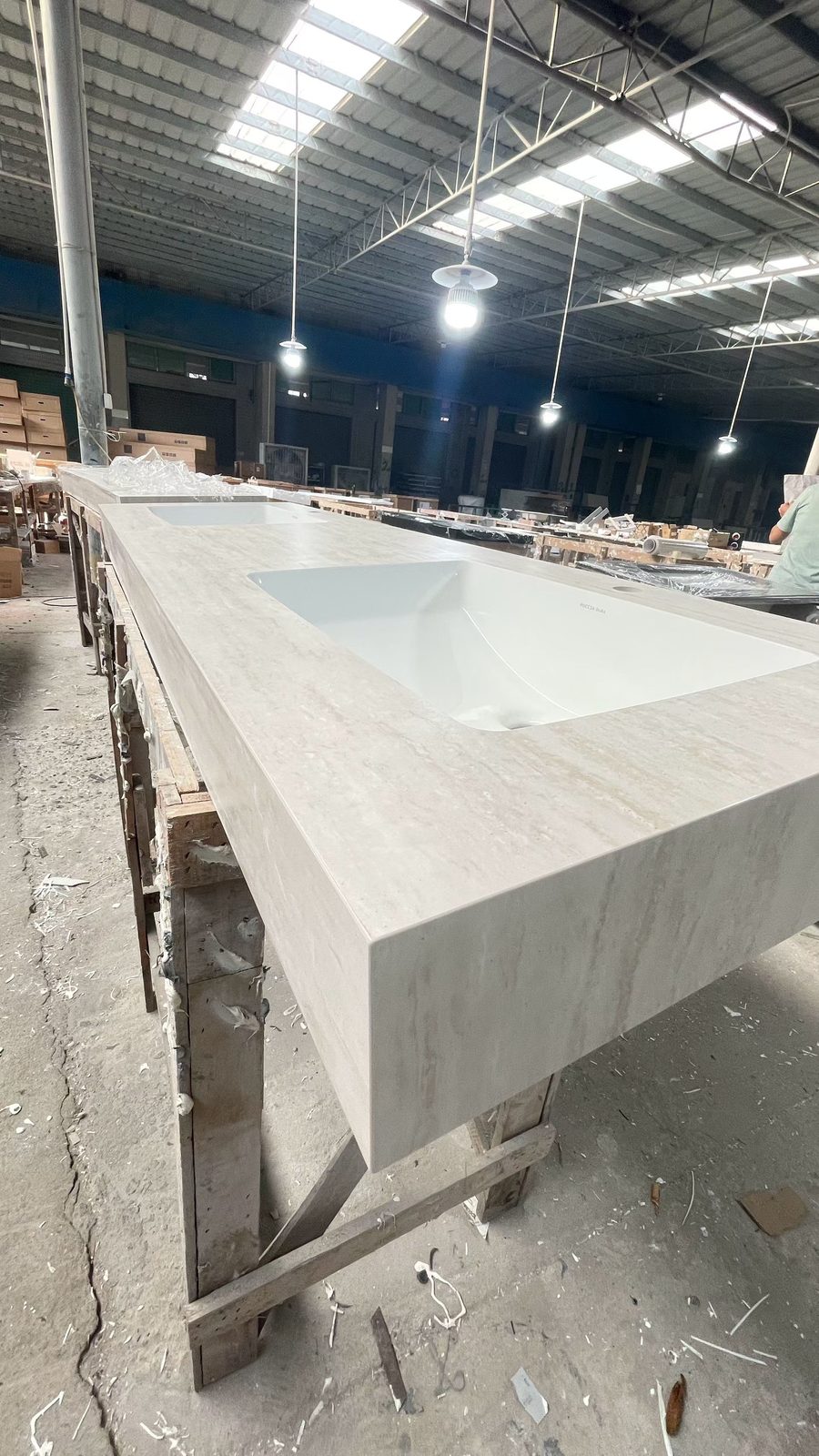
Sintered stone starts as natural mineral particles, fused under heat and pressure into a dense slab, with no resin binder in the mix. The pattern is printed at the surface. Sintered stone is a fused mineral body with a printed surface pattern, and that sentence explains both its strengths and its weak point.
Its defining trait is the fused body: with no resin to soften, the surface tolerates more heat, and the hard mineral face resists scratches and household chemicals. The hot-bent version forms basin and top from one slab. The trade-off sits in repair: a sharp impact can chip an edge, and polishing out damage removes the printed layer and exposes the body colour beneath. Small edge chips can sometimes be rounded and re-polished; a larger chip usually calls for replacement. Weight is the second constraint.
The comparison at a glance
| Solid surface | Sintered stone | |
|---|---|---|
| Body | Mineral filler in resin | Fused mineral particles |
| Binder | Resin throughout | None |
| Pattern | Colour runs through | Printed at the surface |
| Heat | Trivets advised; heat can mark resin | Tolerates more heat |
| Scratches | Scratches readily | Resists scratches |
| Scratch repair | Sands out; deeper marks filled | Light marks may polish out |
| Chips | Less likely; damage filled and sanded | Edge chips possible; large chips replaced |
| Stains | High resistance; dye marks often sand out | High resistance; fused body resists dyes |
| Seam option | Moulded basin, joints sanded to blend | Hot-bent one-piece basin, no glued seam |
| Shape variety | Wide; curves, coves, integrated sinks | Narrower; tooling needed |
| Typical upkeep | Occasional sanding | Mild soap and soft cloth |
Difference 1: Heat, and the trivet rule
Heat is the widest gap between the two materials. Ask the supplier for the written heat statement for the exact product line. Solid surface makers advise keeping hot hair tools off the surface and using a mat under very hot items, since sustained heat can mark or distort resin. Sintered stone tolerates more heat. Its written heat guidance still varies by product line.
Difference 2: Scratches and what repair really means
Scratches are where the two materials trade places. Solid surface scratches more easily, and that sounds like a weakness until the repair is counted. A scratched top sands back with fine abrasive pads, and a fabricator can fill deeper marks and sand the area smooth. The colour runs through the material, so a sanded patch blends in. That renewability suits rental programs and family bathrooms.
Sintered stone resists scratches far longer. The catch is the repair: a light mark may polish out, while a deeper scratch removes the printed pattern layer and leaves a visible trace. Buyers expecting a like-new renewal from sintered stone will be disappointed, so set that expectation before the sale.
Difference 3: Stains, dyes, and daily cleaning
Both materials are non-porous, so neither needs sealing. Solid surface resists stains in daily use, and strong dyes such as hair colour can leave a mark if left sitting. The remedy is the same sanding that fixes scratches. Sintered stone resists dyes and household chemicals from the fused mineral body itself. Hard-water rings still form on either surface, and wipe off with the right cleaner.
Difference 4: Seams and the integrated basin
Seams decide cleaning effort: a seam is a line where grime collects, and a basin with no seam wipes in one pass. Solid surface reaches a seamless look by moulding and gluing: a basin moulded from the same material joins the top, and the joint is sanded until it blends in. Sintered stone reaches a seamless basin by hot-bending: a single slab is formed into basin and top as one continuous piece, with no glued seam at the bend. Forming a curve needs bending capability, so verify any bending claim before ordering.
Difference 5: Weight, shape variety, and cost over time
Sintered stone is heavy, so wall-hung units need proper structural support, and uneven support can crack cut-outs around the basin and tap holes. Solid surface is lighter, and suits wall-hung and curved designs with less structural demand. Shape variety favours solid surface: moulding supports curves and integrated sinks.
Sintered stone usually carries the higher purchase price, and its upkeep costs stay low. Solid surface usually costs less up front, with occasional sanding as upkeep.
What Vora factory records show
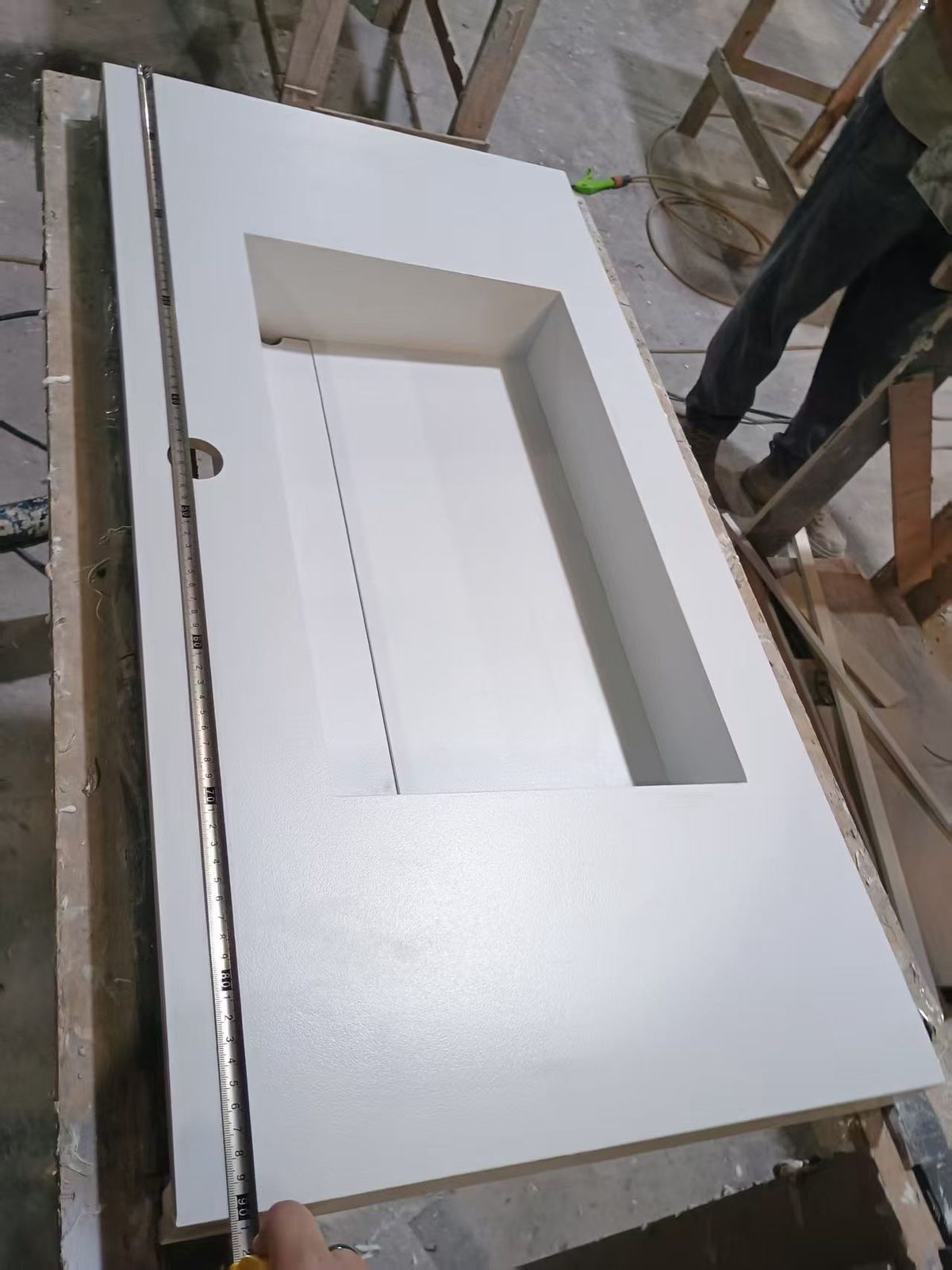
This is the part only a factory can write. Hot-bending is done in-house at the Foshan factory, which can produce the full hot-bent basin and vanity category beyond the catalogue of around 40 models. Basins are pre-drilled for tap holes at the factory. Cabinet bodies are solid wood with a moisture-proof treatment; mirror cabinets are LED with touch control, anti-fog optional; hardware is Kubo/DTC or equivalent-grade.
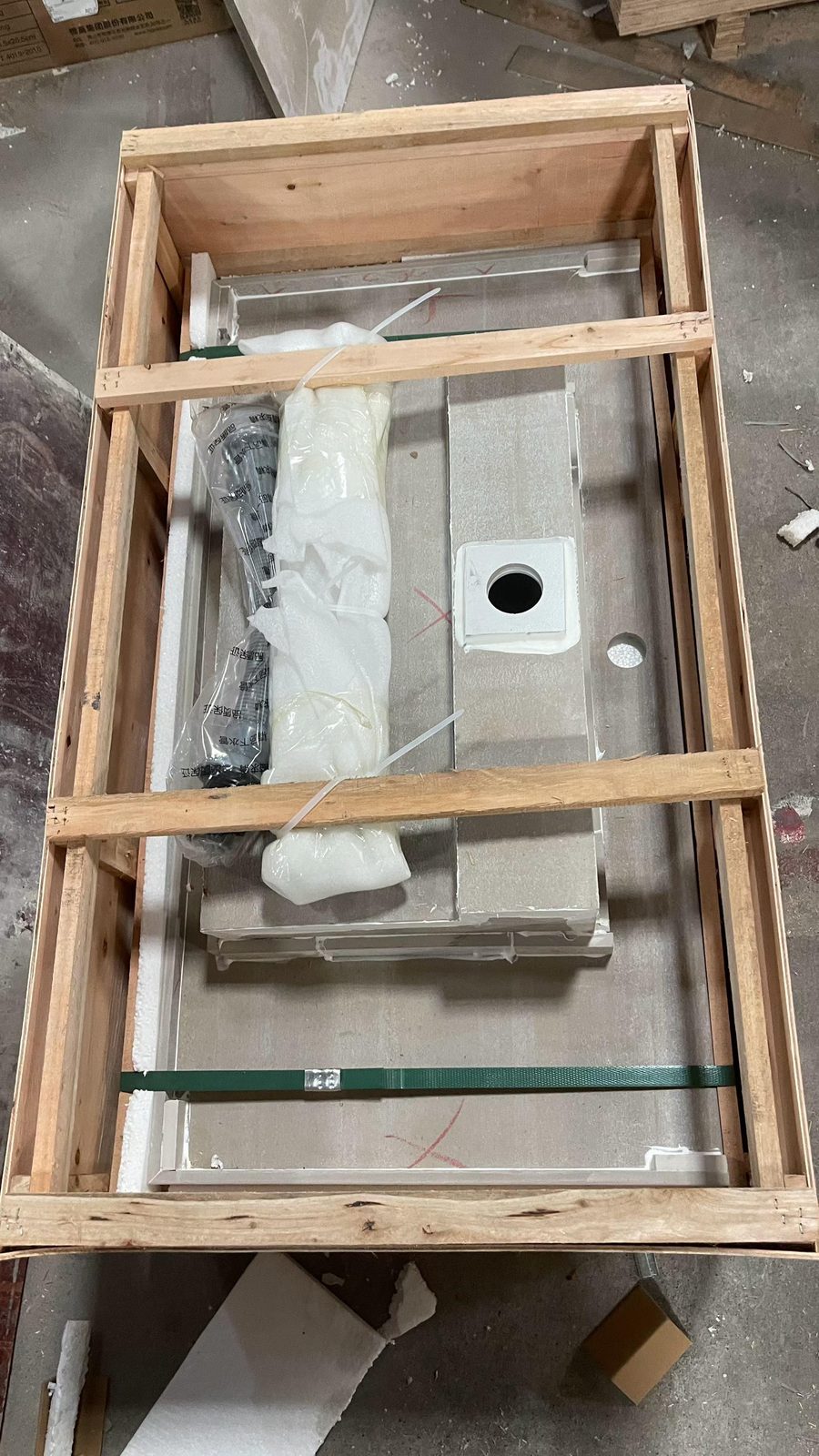
Slab sizes on the factory showroom chart run 800×1400, 900×1800, 800×2000, 900×2000, and 1600×2800 mm, with thicknesses of 6, 11, and 12 mm. A slab spec card shows a matte white travertine-look body, 11 mm thick, 800×2000 mm. Tape-measure checks precede packing, and packing uses foam plus a wooden crate.
Which material for which project
Rental programs and high-turnover bathrooms. Solid surface. The surface can be sanded to a fresh finish between tenancies, and the lower purchase price fits a replacement cycle. Put the trivet rule in the handover pack.
Boutique hotels and premium residential. Sintered stone, and specifically the seamless construction.
Busy family bathrooms. Solid surface. A family bathroom gets hair dye, limescale, and a cleaning routine that varies by week. A surface that can be sanded to a fresh finish absorbs that neglect.
Your own brand line. Sintered stone for the hero models, solid surface for the entry models. The hero models are where the seamless basin and heat tolerance pay off.
Curved and moulded designs. Solid surface. Coves, rounded corners, and integrated sinks suit moulding.
Honest limitations, both sides
Solid surface disappoints where heat and scratches meet daily habits: hot tools left on the top will mark it, and a dark glossy colour shows scratches sooner than a light matte one. Renewal is work the owner has to do or pay for.
Sintered stone disappoints where chips and weight meet real life: a dropped heavy object can chip an edge, and a large chip usually calls for replacement. Bending capability varies by factory, so verify any bending claim before ordering. Our honest downsides guide opens with the line that sintered stone earns its place in bathrooms through a seamless basin shape and a hard face that handles daily washing with little upkeep.
Neither material is the wrong answer: the question is which failure the project can absorb, heat marks that sand out or chips that call for replacement.
Frequently asked questions
Which stains more easily, solid surface or sintered stone?
Both resist stains in daily use, since both are non-porous. Solid surface can pick up marks from strong dyes, and those marks often sand out. Sintered stone resists dyes from the fused mineral body itself.
Can scratches be repaired on a solid surface basin?
Yes, in most cases. Light scratches on solid surface sand out with fine abrasive pads, and deeper marks can be filled and sanded. Scratches on sintered stone are harder to address: a light mark may polish out, while a deeper scratch usually stays visible.
Can a solid surface basin handle hot water and hot hair tools?
Hot tap water is fine for both materials. With concentrated heat, solid surface makers advise keeping hot hair tools off the surface and using a mat, since sustained heat can mark resin. Sintered stone tolerates more heat, and its written heat guidance still varies by product line.
Which material gives a seamless basin with no joint?
Both can. Solid surface basins are often moulded as one piece with the top, with glued joints sanded to blend into the surface. Sintered stone basins can be hot-bent from a single slab into a one-piece unit.
Which costs more to own over time?
Sintered stone usually carries the higher purchase price, and its upkeep costs stay low. Solid surface usually costs less up front, with occasional sanding as upkeep.
Talk to the factory
If you are choosing between the two for a real order, send the project type, sizes, and the failure you most want to avoid. Browse the range for current models, use the configurator to test basin finishes, or request a quote with this comparison attached.
When you inquire: a member of the Vora Surfaces factory team replies through vorasurfaces@gmail.com or the contact form. Your details are used only for this inquiry, with no mass mailing. No fixed turnaround is promised here.
Sources
- Houzz, “How to Choose the Perfect Composite Worktop for Your Kitchen”: https://www.houzz.ie/magazine/how-to-choose-the-perfect-composite-worktop-for-your-kitchen-stsetivw-vs~104065422
- Granite and Quartz Worktops, “Dekton vs Corian: How to Decide”: https://granite-and-quartz-worktops.co.uk/dekton-vs-corian-how-to-decide/
- GELANDY / Bienstone, “Quartz vs Solid Surface vs Sintered Stone”: https://www.bienstone.com/quartz-vs-solid-surface-vs-sintered-stone-performance-design-fabrication-cost-compared.html
- Community pain points: 06-community-pain-points.md (8, 9, 10, 15, 21, 39).
- Factory facts: 07-verified-factory-facts.md (in-house hot-bending, moisture-proof solid wood cabinets, Kubo/DTC hardware, pre-drilled tap holes, QC checks, foam plus wooden crate packing).
Specifications verified against Vora Surfaces factory records. Editorial review applied. Spotted an error? Email corrections to vorasurfaces@gmail.com.
Frequently asked questions
Which stains more easily, solid surface or sintered stone?
Both resist stains in daily use, since both are non-porous. Solid surface can pick up marks from strong dyes, and those marks often sand out. Sintered stone resists dyes from the fused mineral body itself.
Can scratches be repaired on a solid surface basin?
Yes, in most cases. Light scratches on solid surface sand out with fine abrasive pads, and deeper marks can be filled and sanded. Scratches on sintered stone are harder to address: a light mark may polish out, while a deeper scratch usually stays visible.
Can a solid surface basin handle hot water and hot hair tools?
Hot tap water is fine for both materials. With concentrated heat, solid surface makers advise keeping hot hair tools off the surface and using a mat, since sustained heat can mark resin. Sintered stone tolerates more heat, and its written heat guidance still varies by product line.
Which material gives a seamless basin with no joint?
Both can. Solid surface basins are often moulded as one piece with the top, with glued joints sanded to blend into the surface. Sintered stone basins can be hot-bent from a single slab into a one-piece unit.
Which costs more to own over time?
Sintered stone usually carries the higher purchase price, and its upkeep costs stay low. Solid surface usually costs less up front, with occasional sanding as upkeep.
Sourcing hot-bent basins for your next project?
Send your drawings and target quantities — we'll confirm feasibility from the factory floor.
Configure your inquirySee the products behind these guides: production cabinet styles and buying terms for buyers & OEM.
Specifications verified against Vora Surfaces factory records. Editorial review applied. Spotted an error? Email corrections to vorasurfaces@gmail.com.