
Factory guide
Ceramic vs Sintered Stone Basins: An Honest Comparison for Buyers
By Vora Surfaces Factory Editorial Team · Published 2026-10-10 · Foshan, China
A ceramic basin is clay fired under a glass glaze — the glaze does the work of resisting water and stains. A sintered stone basin is natural minerals pressed under high pressure and kiln-fired until they fuse into a dense, non-porous slab — the body itself resists water and stains, with no glaze involved. Neither is the wrong answer. They fail in different places, cost different money, and suit different projects.
That is the honest version. The rest of this guide walks through where each material wins, where each one quietly disappoints, and how one factory runs both lines side by side — because we do.
Why this comparison matters right now
Scroll many factory accounts on social media and you’ll meet a familiar script: “Stop buying basic ceramic sinks.” It is the standard line from manufacturers pushing sintered stone — us included, on our good days. And it seems to work. Factory accounts on social media routinely itemize ceramic’s failure points — scratched glaze, rim chips, dulled finishes — and those posts draw price inquiries. Buyers are doing their homework.
The gap is that the impartial version is rare. Factory accounts sell; retailers list features. The English-language buyer who wants a straight answer — for a hotel tender, a rental program, a private-label line — gets marketing or nothing. This guide is our attempt at the straight version, written by a factory that sells both.
The quick comparison
| Ceramic basin | Sintered stone basin | |
|---|---|---|
| Body | Clay, glazed surface | Fused minerals, non-porous through the body |
| Stain resistance | High while glaze intact; stains settle where glaze wears | High; no coating layer to wear through |
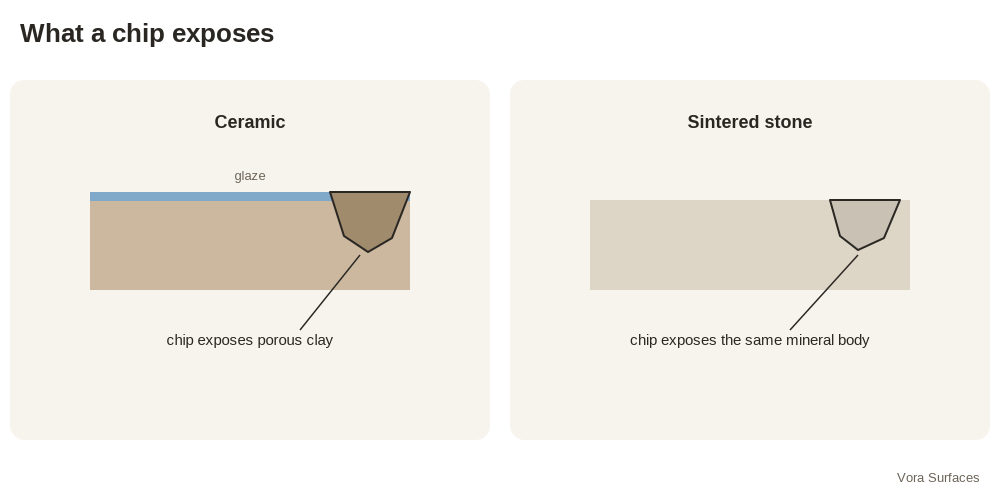
| Chip behavior | Chip exposes porous clay under the glaze | Chip exposes more of the same mineral body |
| Surface repair | Glaze can’t be re-applied on site | Small edge chips can sometimes be rounded and re-polished |
| Shape variety | Very wide — molds cheaply into many forms | Narrower — bending and cutting need real tooling |
| Typical unit cost | Lower | Higher (material + kiln + tooling) |
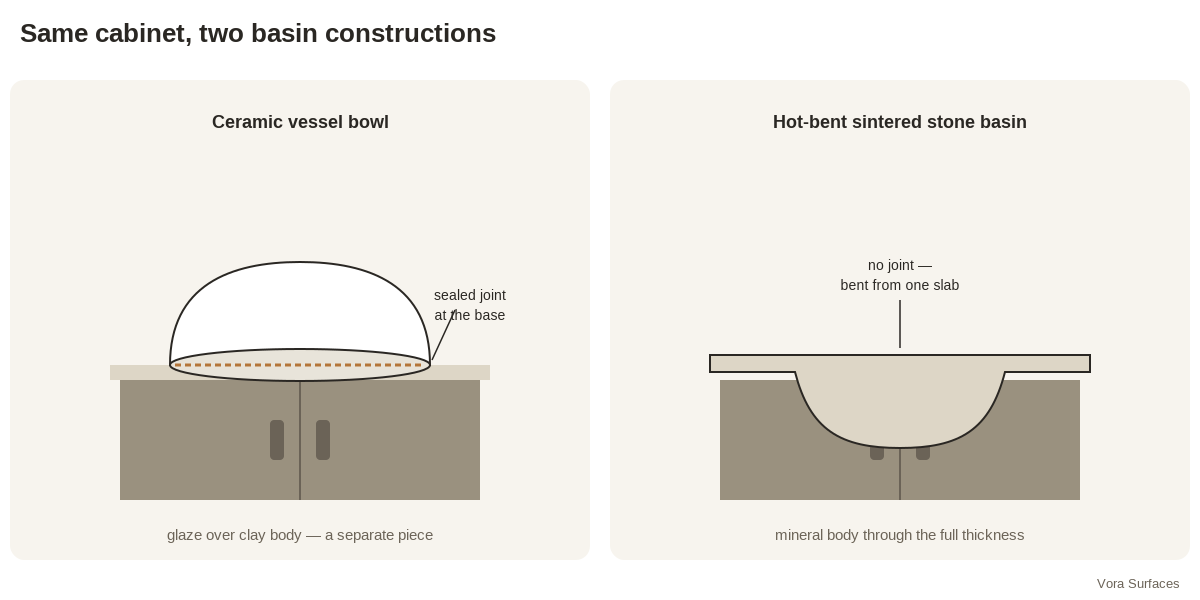
| Seam options | Joined to countertop with caulk/silicone line | Can be hot-bent into a one-piece integrated basin |
| Sealing needed | No | No |
| Supply chain | Deep and mature | Younger, fewer experienced suppliers |
How durability plays out over years
Durability here means how each basin looks and holds up after years of daily use, not how it looks on delivery day.
On ceramic, the glaze does the protecting, and the glaze ages. Fine crazing — hairline cracks in the glaze — can appear around the drain after years of hot and cold water cycling. Rim chips expose the clay body underneath, and stains seep into the exposed clay in a way they never did while the glaze was intact. The basin still works, but the damage shows, and it shows where guests and cleaners look.
On sintered stone, stain resistance lives in the mineral body, so there is no coating to wear through. A chip exposes more of the same mineral body, in the same color family, with the polished finish gone at the damaged spot. The surface keeps resisting stains around the damage, because the resistance was never a surface layer.
Repair limits decide what happens next. A ceramic glaze cannot be re-applied on site. Small edge chips on either material can sometimes be rounded and re-polished by a fabricator. A large chip on either material means replacement. On a fitted vanity with a one-piece integrated top, that replacement means removing the top as well as the basin.
What the price gap actually pays for
The price gap between the two materials comes from how each one is made and supplied. Ceramic molds cheaply, so factories can offer many shapes from tooling that already exists, and the supply chain behind it runs deep — molds, glazes, spares, and installers who have fitted ceramic for decades.
Sintered stone costs more at every step: the mineral material itself, the kiln time, and the tooling for bending and cutting. Fewer suppliers run real bending capability, so the buyer pool for quotes stays smaller and lead times depend on a shorter list of factories.
Whether the premium earns its keep depends on the project. Boutique hotels and premium residential jobs pay it for durability — a basin that keeps its finish through years of guest turnover and hard cleaning routines. Own-brand hero models pay it for the same reason: the vanity carries the buyer’s name, and the callback cost of a stained or crazed basin lands on that name. Rental turnover and lowest-bid tenders should skip it — a basin replaced on the turnover cycle never gets the years the premium buys, and a tender decided on unit price has no line for longevity.
Cleaning: one pass or three
Cleaning effort follows construction as much as material, and the two materials age into different cleaning jobs.
A worn ceramic glaze traps stains. Once crazing or scratches break the smooth fired surface, soap, dye, and limescale settle into the texture, and the same cleaner that worked on a new basin leaves marks behind. Sintered stone carries no coating, so there is no worn layer for grime to lodge in — the surface that faces the cleaner is the same mineral body it was on day one.
Construction decides how many surfaces the cleaner has to reach. A one-piece integrated basin wipes in a single pass: basin and countertop form one continuous surface, with no rim or caulk line behind it. A ceramic vessel bowl asks for three — inside the bowl, outside the bowl, and the counter behind it, where water and dust collect out of easy reach.
Hard-water rings sit outside this comparison. They come from the water, not the basin, and they form on either material in a hard-water home. A ring on sintered stone wipes off the same mineral surface; a ring on ceramic wipes off the glaze — until the glaze wears, and then the ring has somewhere to hold.
What ceramic gets right
Price. Ceramic is among the lowest-cost basin materials that still look like a finished product. When the tender goes to the lowest compliant bid, or the margin per unit decides the whole order, ceramic can be the right engineering choice on its own merits, not a fallback.
Shape variety. Ceramic molds cheaply. Round, rectangular, asymmetric, fluted, compact cloakroom sizes — the industry has spent decades tooling most conceivable forms. If the design brief calls for an unusual shape at a reasonable price, ceramic probably already exists in it.
Supply chain maturity. Installers are most familiar with ceramic — replacement parts, matching taps, and drain assemblies are stocked in most markets, and the parts ecosystem is close to complete. That maturity is a real cost saver on projects with tight timelines and local installers.
Where ceramic disappoints. The glaze is everything, and the glaze ages. Hairline crazing — fine cracks in the glaze surface — can appear around drain areas after years of thermal cycling, and once the glaze is breached, stains and bacteria get a foothold the glaze was keeping them from. Chips at rims and edges expose the porous clay body, which stains readily. Aggressive cleaners dull older glazes faster. None of this is a secret; it is just the part most brochures leave out.
What sintered stone gets right
Stain and chemical resistance from the body itself. Sintered stone’s defining property is that its resistance lives in the fused mineral body, not in a coating. There is no glaze to scratch through, no resin binder to yellow. Hard water, hair dye, toothpaste, common bathroom cleaners — the surface takes normal abuse without drama. That is the claim the non-porous mineral body outperforms a glaze coating that can scratch through, and it is the material’s main selling point.
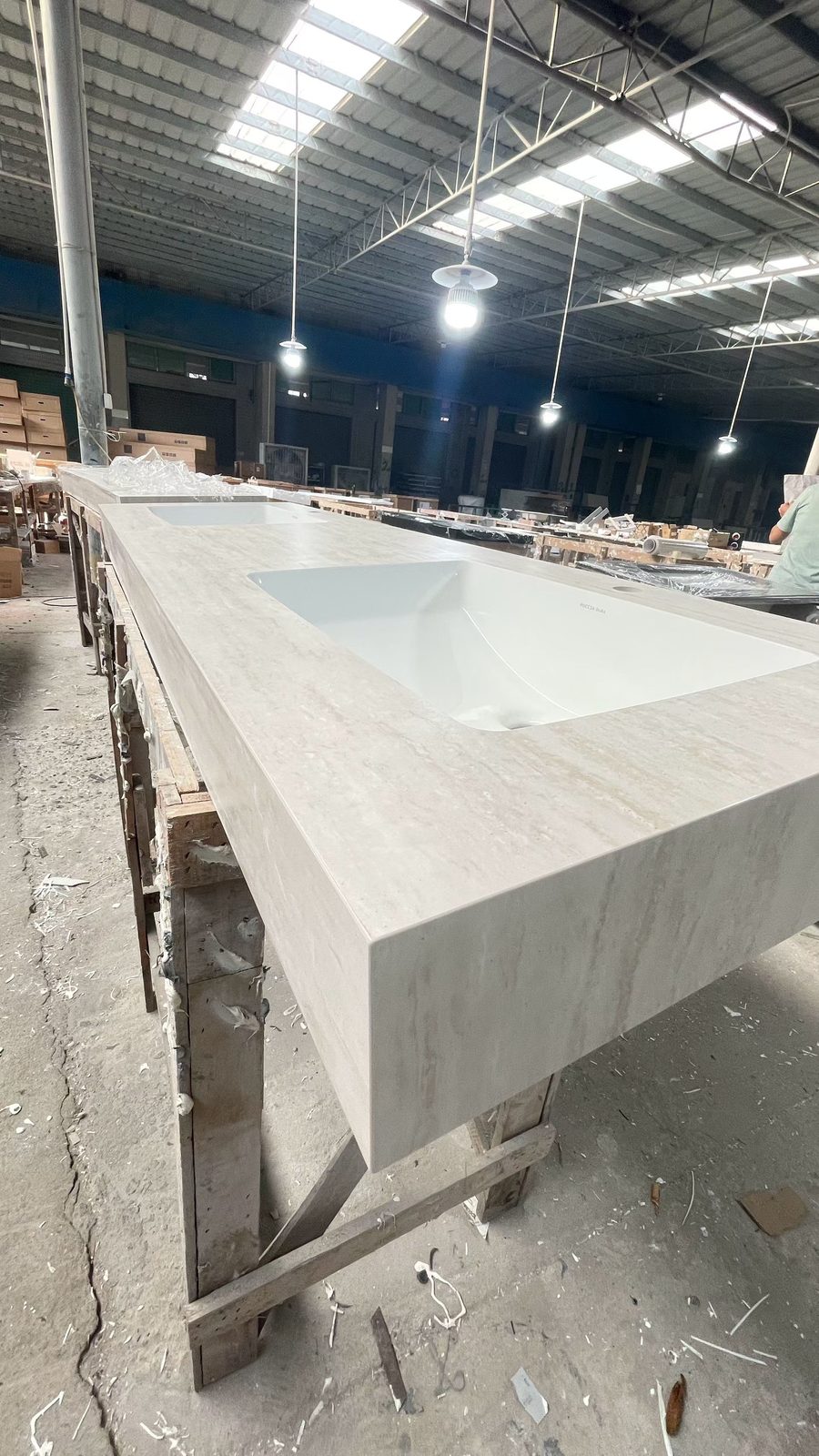
The seamless option. Hot-bending lets a single slab be formed into a one-piece basin with no glued seam at the bend — basin and countertop as one continuous surface. No rim, no caulk line, no lip for water to sit behind. For cleaning, seamless construction is the practical edge. Seams are where grime collects first; the hot-bent curve has nothing to scrub around.
Where sintered stone disappoints. It costs more — material, kiln time, and mold investment all price in. Repairs are limited: a sharp, concentrated impact can chip an edge, and polishing out damage removes the surface layer and exposes the body color beneath, so a bad chip is a replacement, not a repair. It is heavy, so wall-hung installations need proper structural support. And the supplier base is young: fewer factories have real bending capability, which is why our companion guide How to verify a “hot-bent” claim before you pay exists — “hot bending” shows up in listings from sellers who don’t own a kiln.
How one factory runs both lines
This is the part only we can write. Vora Surfaces runs two product lines, and they exist for different customers:
The volume line: 14 production cabinet models with ceramic and artificial-stone basins. These come from our sub-brand’s cabinet catalogue — production cabinet styles paired overwhelmingly with ceramic basins. Not a single one uses a hot-bent sintered stone basin. That line moves on price, availability, and the most mature supply chain of the three. For budget hotel chains, rental programs, and price-driven tenders, it is the line we quote — and we say so openly.
The flagship line: hot-bent sintered stone integrated basins, bent in-house. This is the process we are known for — slab heated until pliable, formed over a mold, then cooled so the curve sets — done at our own Foshan factory, not outsourced. The catalogue covers around 40 models in the common 60–120 cm widths — browse the hot-bent basin range — and the factory builds the full hot-bent category beyond the catalogue, including custom configurations. Solid wood cabinet bodies, smart LED mirror cabinets with touch control, Kubo/DTC or equivalent-grade hardware — the whole unit is built around the basin.
The two lines serve different buying logic — one for price-driven orders, one for projects where the failure budget decides the spec. Spec the volume line where the unit price decides the order; spec the hot-bent line where the project’s failure budget decides it. We make money on both, so we have no reason to steer you wrong.
Which material for which project
Budget hotel chains and rental programs. Ceramic. The replacement cycle beats the longevity math, and the unit price decides the tender. Spend the savings on better hardware — the verification checklist in our wholesale guide applies to any basin purchase, not just sintered stone.
Boutique hotels and premium residential. Sintered stone, and specifically the seamless construction. The callback math is brutal in hospitality: one warranty claim — a replacement basin shipped internationally, an installer paid twice, a room out of service — can erase the material premium across the whole order. Stained caulk lines and crazed glazes are exactly the complaints that generate those callbacks.
Your own brand line. Sintered stone for the hero models, ceramic for the entry models. If the vanity carries your name, the hero models are where the better material pays off. The entry range competes on price, where ceramic’s cost and shape variety are genuine assets.
Fast-turnaround samples and odd geometries. Ceramic again — and if you are comparing constructions rather than materials, glued sintered stone fills this slot too. No mold means no tooling wait; a saw cuts any angle. Our material comparison for those edge cases sits in Sintered stone vs ceramic, quartz, and solid surface.
Busy family bathrooms. This is the quiet case for sintered stone that rarely makes the shortlist. A family bathroom gets hair dye, limescale, and a cleaning routine best described as aspirational. A seamless one-piece basin removes the exact seams where that neglect shows first.
A note on what we don’t claim
We publish no hardness numbers, no water-absorption figures, no laboratory certificates in this guide — because unreplicated numbers in marketing copy are exactly how buyers get burned. What we do publish: The honest limitations of sintered stone on our basics page, including the weight, the cost, and the repair problem. Read that section before you believe any factory’s spec sheet, including ours.
Talk to the factory floor
If you are deciding between the two for a real order, tell us the project type and we’ll tell you straight which line fits. We quote ceramic-based volume cabinets and hot-bent sintered stone units from the same desk, so there is little incentive to upsell you — just the answer.
Request a quote or browse the range — and if you want to spec finishes yourself, the configurator carries basin finish options to play with.
When you inquire: a Vora team member replies (not a bot). Your details are used only for this inquiry — no mailing lists, no forwarding. We don’t promise a response time we can’t verify, but inquiries are read by the people who build the basins.
Specifications verified against Vora Surfaces factory records. Editorial review applied. Spotted an error? Email corrections to vorasurfaces@gmail.com.
Frequently asked questions
Which stains more easily over time, a ceramic basin or a sintered stone basin?
Both resist stains when new, but they age differently. Ceramic relies on its glaze; once the glaze wears, scratches, or crazes, stains can settle into the exposed body and marks get harder to remove. Sintered stone's stain resistance comes from the fused mineral body itself, so there is no coating layer to wear through. Hard-water rings still form on either — that is a water chemistry issue, not a material failure — and wipe off with the right cleaner.
What does a chip look like on each material?
On ceramic, a chip removes the glaze and exposes the clay body underneath, which is visibly duller and can absorb stains at the spot. On sintered stone, a chip exposes more of the same mineral body — same color family, but the polished surface finish is gone at the damaged area, so it reads as a dull spot. Small edge chips on either material can sometimes be rounded and re-polished by a fabricator; large chips mean replacement.
Can I use strong bathroom cleaners on sintered stone basins?
Sintered stone handles most household bathroom cleaners without the etching that acids cause on polished marble or travertine. But 'resistant' is not 'invincible': abrasive powders and scouring pads will dull the surface over time, and damage to a sintered stone surface is difficult to reverse since repairs are limited. Treat it with normal care and it will be fine.
Which basin material is easiest to keep clean?
Construction matters more than material here. An integrated one-piece basin — basin and countertop formed as a single piece — has no rim or caulk line for grime to collect behind, so it wipes clean in one pass. That is why hot-bent sintered stone designs have a natural cleaning advantage. A ceramic vessel bowl, by contrast, forces cleaning inside, outside, and behind the bowl. Choose integrated construction first, then compare materials.
Do ceramic or sintered stone basins need sealing?
Neither needs sealing in normal bathroom use. Ceramic's glaze is its seal; sintered stone is non-porous through the body. If a supplier tells you a sintered stone basin needs periodic sealing, that is a red flag — it signals they may be selling you something else entirely.
I'm buying for a rental property. Which material makes sense?
Ceramic, in most cases. Rental bathrooms get replaced on the turnover cycle, so the material's longevity rarely pays off within one tenancy. Paying a premium for a basin that outlasts the tenancy is money spent on someone else's problem. Save sintered stone for projects where longevity is the point: hotels, premium residential, or your own brand line.
How does durability differ between ceramic and sintered stone basins over time?
On ceramic, the glaze ages: fine crazing can appear around the drain, rim chips expose the clay body, and stains seep into the exposed clay. On sintered stone, stain resistance lives in the mineral body, so there is no coating to wear through and a chip exposes more of the same mineral body. Repair limits are tight on both: a ceramic glaze cannot be re-applied on site, small edge chips can sometimes be rounded and re-polished, and a large chip means replacement.
When is it worth paying more for a sintered stone basin?
The premium comes from material, kiln time, and tooling, and fewer suppliers run real bending capability. It earns its keep on boutique hotels, premium residential jobs, and own-brand hero models, where durability and fewer callbacks matter. Rental turnover and lowest-bid tenders should skip it: a basin replaced on the turnover cycle never gets the years the premium buys.
Which basin is easier to clean — ceramic or sintered stone?
A worn ceramic glaze traps stains once crazing or scratches break the fired surface, while sintered stone carries no coating for grime to lodge in. Construction matters as much as material: a one-piece integrated basin wipes in a single pass, while a ceramic vessel bowl needs cleaning inside, outside, and behind the bowl. Hard-water rings form on either material — they come from the water, not the basin.
Sourcing hot-bent basins for your next project?
Send your drawings and target quantities — we'll confirm feasibility from the factory floor.
Configure your inquirySee the products behind these guides: production cabinet styles and buying terms for buyers & OEM.
Specifications verified against Vora Surfaces factory records. Editorial review applied. Spotted an error? Email corrections to vorasurfaces@gmail.com.