
Factory guide
How a Hot-Bent Sintered Stone Basin Is Made: 6 Steps Inside the Factory
A hot-bent sintered stone basin is a bathroom basin thermoformed from a single slab: the slab is heated until it turns pliable, shaped over a mold in one continuous motion, then cooled so the curve holds. The result is a one-piece basin — bowl, apron, and tap deck formed together, with no glued seam at the bend.
By Vora Surfaces Factory Editorial Team · Published 2026-10-23 · Foshan, China
In short: A hot-bent sintered stone basin starts as one flat slab, is heated until pliable, bent over a mold, then cooled so the curve holds. The factory then drills tap holes, inspects each piece, and packs it in foam plus a wooden crate. This walkthrough covers all six steps, with the real limits spelled out.
Buyers keep asking the same question once they see a curved basin listing: how is this actually made? Factories already title their videos “hot bending sintered stone washbasin” to teach the market, and Google’s “People also ask” box poses the bending question verbatim — yet no factory has published a full step-by-step walkthrough in English. This guide is that walkthrough, written from our own bending line in Foshan. Steps marked as our factory practice describe what we do; steps marked as standard industry practice describe the process as equipped factories run it generally.
Step 1 — Select the blank
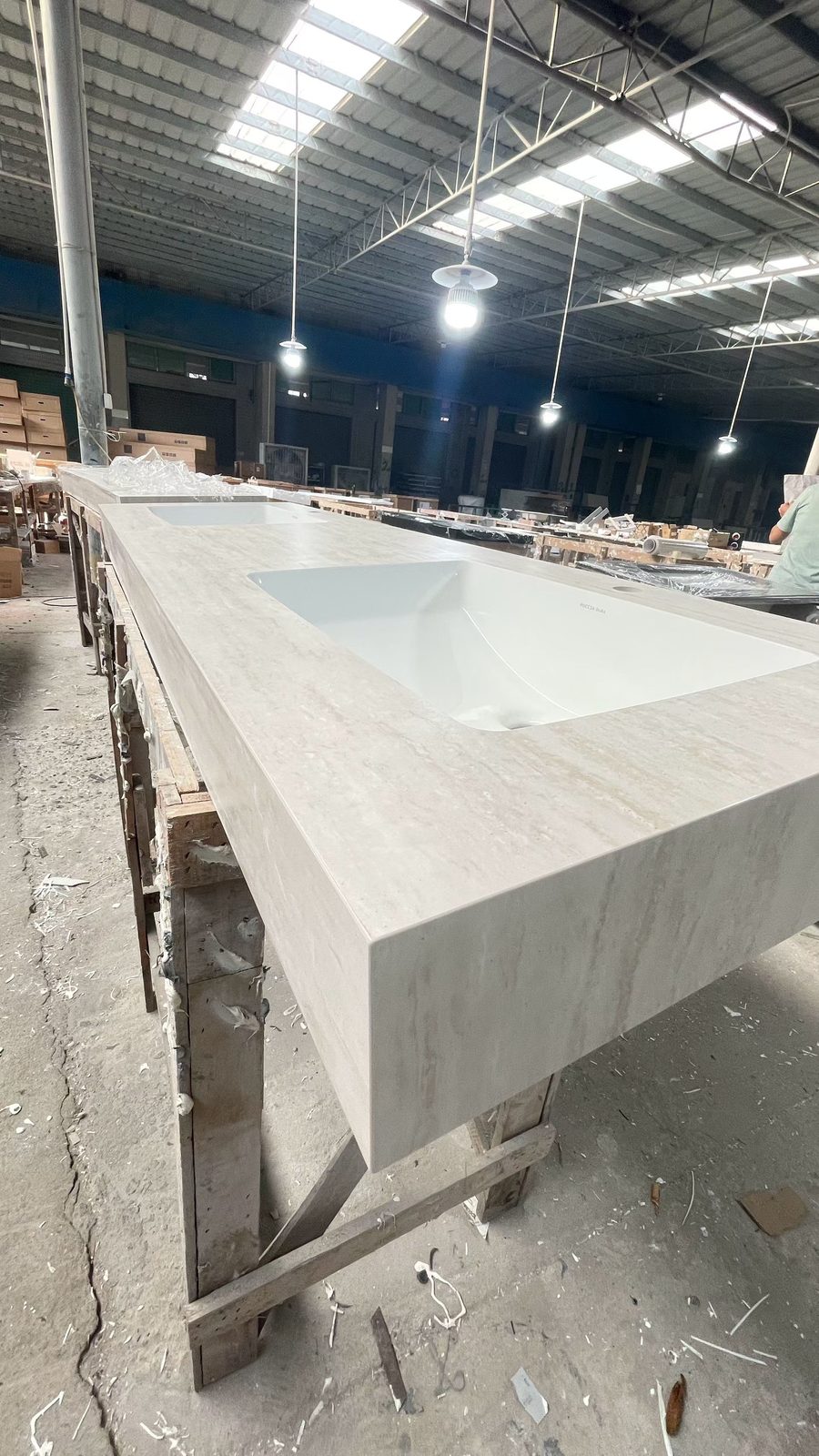
Every basin starts as a flat blank cut from a sintered stone slab, and the blank decides more than the final color does. Slab choice sets the thickness of the finished basin, the maximum bowl depth the mold can reach, and how the pattern reads across the curve. Our showroom material chart lists slabs in sizes up to 1600×2800 mm and thicknesses of 6, 11, and 12 mm — the material reference our blank sizing works from. Before cutting, the operator checks the slab for consistent tone and surface defects, because a flaw pressed into a bend becomes a flaw in every basin from that run.
Step 2 — Cut the blank to the mold’s size
The blank is cut to the dimensions its mold requires — wide enough to wrap the profile, long enough to cover bowl, apron, and tap deck in one piece. This is standard industry practice: the mold geometry dictates the blank, not the other way around. A blank cut too small pulls thin at the bend; one cut too large wastes material and complicates handling. Blank sizing is also where material cost gets decided: tight nesting of blanks on the slab keeps waste low, which matters on custom and double-basin orders where every blank is large. The tap-hole deck stays part of the same blank, so the later drilling step (Step 6) works on the same continuous piece.
Step 3 — Heat the blank until pliable
The blank goes into a bending kiln and is heated across its full surface until the stone turns pliable. This is the step buyers are most curious about, and the one where factories differ least in concept but most in control: the entire blank must reach working pliability evenly. Evenness matters more than peak heat — a cool spot in the blank becomes a stress point in the finished basin, which is exactly the kind of defect that shows up months later as a hairline. Hot bending is one of Vora’s in-house processes: the kiln, the molds, and the QC bench all sit under the same roof.
One correction worth making here: some search results describe room-temperature “cold bending” of sintered stone as a real option. We have found no verified cold-bending process for sintered stone — at room temperature the slab is rigid, and forcing a bend cracks it. Heat is the only thing that makes it move.
Step 4 — Bend over the mold
While pliable, the blank is laid over the mold and shaped into the basin profile — bowl, apron, and tap deck — in one continuous motion. Nothing is cut apart at the bend, so there is no joint to glue and no joint to fail later. The mold defines the geometry, so every basin from the same mold carries the same curve, which is what makes hot bending repeatable at production scale. This single-piece construction is the difference the whole guide builds on: a hot-bent basin is bent from a single heated slab — no glued seam at the bend.
Our line handles the full hot-bent basin category, not a fixed model list — including custom orders at any time, such as extra-wide 72-inch-plus double-basin configurations and other non-standard sizes. Custom shaping is part of the same in-house capability: our one-piece shower trays, for example, are formed with sloped drainage to a square drain and faucet-hole panels cut to order. The sequence below is the standard the industry follows; the steps any equipped factory follows.
Step 5 — Cool under control to lock the curve
The shaped blank stays on its mold while it cools, and the curve locks in as the stone sets. Cooling is deliberately unhurried: rushing it can introduce warp or internal stress, the same defect class as uneven heating in Step 3, just arriving later in the cycle. Kiln designs and cooling schedules vary from shop to shop. Every equipped factory treats this as standard industry practice: cooling follows a controlled schedule on every run.
Step 6 — Drill, inspect, pack
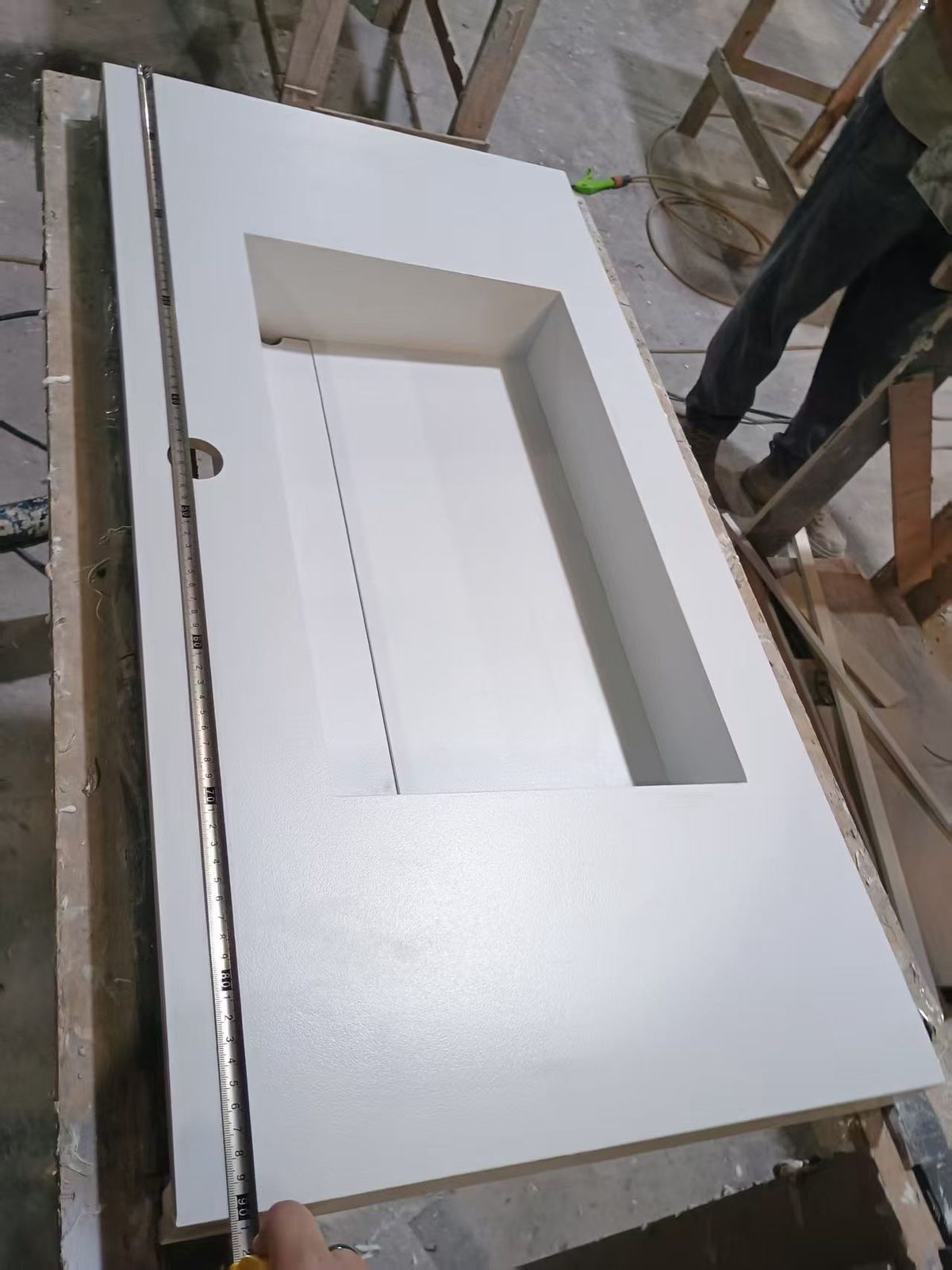
Only now does the basin meet tools again. Vora basins leave the factory with tap holes pre-drilled to mainstream mixer tap specs — confirm the hole sizing at order time — and the drain cutout is made at the factory too. Then each top goes through QC: a tape-measure check of the basin top before packing, which our own QC photos show on the packing bench.
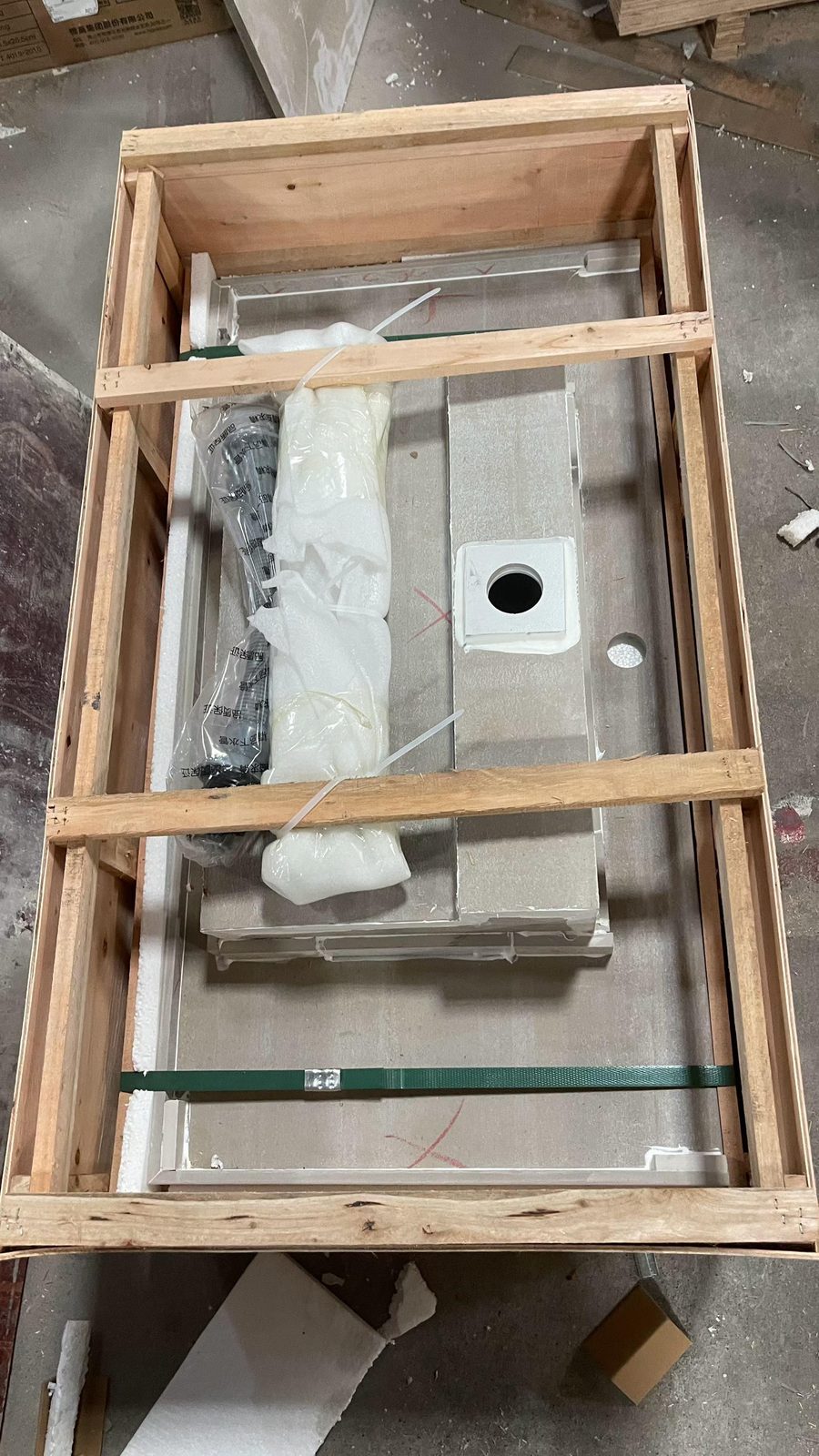
Packing is foam plus a wooden crate, with finished crates stacked in the warehouse before loading. Stone tops break in transit far more often than in use: stone vanities crack in transit far more often than they crack in use. The crate is the last factory step that protects the first five.
What hot bending can’t do — honest limits
A factory guide that only sells the process is a brochure. Here are the real constraints, stated plainly.
Tight inside corners. A bend produces broad curves, not folded-sharp 90° inside corners. Designs that need crisp folded corners use a different construction; a hot-bent profile keeps generous radii because the mold has to release the cooled stone.
Size caps follow the slab. Bowl depth and overall width are limited by the blank that fits the slab and the kiln. Very deep double bowls or very long one-piece runs need the blank size to exist first — confirm feasibility with the factory before finalizing drawings.
The surface pattern is printed. Sintered stone patterns sit on the surface layer; a deep chip can expose the base body color underneath. Bending does not change this. A sintered stone basin cleans with warm water, mild dish soap, and a soft cloth — most marks stay on the non-porous surface, where a cloth can reach them — but edges deserve protection in transit and during installation, since field repair of a deep chip is limited.
Heat makes it pliable once; it does not make it unbreakable. A sharp, concentrated impact can chip an edge, and an unlevel cabinet lets the top flex around cutouts and corners. The process removes the glued joint as a failure mode — it does not remove physics.
Hot water vs boiling water. Everyday hot water is normal use. A single-sample commission test (report G23-WT10751E, JC/T 2116-2012, passed — cited here as a single-sample commission test, not a product certification) showed no cracking or discoloration after 60 minutes of 65°C hot water spray, alongside 0.07% water absorption and no damage under a 1.1 kN static load. That is one sample’s result, not a rating for every unit. Pouring a full kettle of boiling water straight from the stove into any basin remains a bad habit.
Who this matters for
Importers comparing suppliers should ask the one question that settles construction claims: is the basin bent from a single slab, or assembled from glued pieces — then ask for a photo of the bend from underneath or a short clip of the bending step. A factory that actually hot-bends shows its line without hesitation. Browse the product range to see the profiles our molds produce, open the configurator to test a size against your project, or send drawings for a custom profile.
Request a quote — send your target sizes or drawings through the contact page. Our export team replies with a priced specification based on your drawings. Your details are used only for this inquiry; we do not add you to any mailing list.
Frequently asked questions
Can sintered stone really be bent?
Yes — with heat. In hot bending, a flat slab is heated until pliable, shaped over a mold, then cooled so the curve holds. At room temperature the slab is rigid, and no verified cold-bending process for sintered stone has been found; cold bending belongs to acrylic and plastic sheets.
Is a hot-bent basin stronger than a glued one?
The bend carries stress through solid stone, while a glued joint concentrates stress along the adhesive line. That difference is why the bend area on a hot-bent basin has no seam to yellow, trap grime, or open over time. The basin still needs a level cabinet and correct support — hardness resists scratches; correct cabinet support is still required.
Why do hot-bent basins cost more than glued ones?
A glued basin is cut and assembled; a hot-bent one needs a mold plus a full heat-and-form cycle, and the mold cost spreads across the run. You are paying for the seamless bend and the extra factory step, not just the material.
Can I order non-standard sizes or a double basin?
Yes. Vora supports custom orders anytime, including extra-wide 72-inch-plus double-basin configurations and other non-standard sizes. Confirm exact dimensions, tap-hole positions, and drain placement at the order stage.
What happens if the basin arrives cracked?
Inspect before signing: tape-measure the top, check corners and the drain cutout, and photograph any damage before unpacking further. Vora packs basin tops in foam plus a wooden crate. A cracked top is a replacement conversation with your supplier — confirm their damage policy before you place the order.
Can hot water damage a hot-bent basin?
Day-to-day hot water is normal use. In a single-sample commission test (report G23-WT10751E, not a product certification), a sample withstood 65°C hot water spray for 60 minutes with no cracking or discoloration. As a habit, avoid pouring a full kettle of boiling water straight from the stove into any basin.
Sourcing hot-bent basins for your next project?
Send your drawings and target quantities — we'll confirm feasibility from the factory floor.
Configure your inquirySee the products behind these guides: production cabinet styles and buying terms for buyers & OEM.
Specifications verified against Vora Surfaces factory records. Editorial review applied. Spotted an error? Email corrections to vorasurfaces@gmail.com.