
Factory guide
Vanity Hardware That Actually Lasts: Soft-Close Slides & Hinges Buyers Should Spec (and the Failure Signs to Check)
Soft-close vanity hardware is the set of drawer slides and door hinges fitted with dampers that pull a drawer or door through its final stretch of travel and land it quietly against the cabinet. Its durability decides how a vanity feels after the first year of daily use, and buyers can judge it with three hands-on checks at delivery plus four questions at order time.
By Vora Surfaces Factory Editorial Team · Published 2026-10-24 · Foshan, China
In short: Soft-close slides and hinges fail in four visible ways — drawers that stop short, bounce back, judder, or resist. Most cases trace to hardware grade, adjustment, or a moisture-swollen cabinet. Three delivery checks and four ordering questions help buyers catch problems on every unit before installation.
What does soft-close hardware do on a bathroom vanity?
A soft-close slide or hinge adds a small damper to the last part of the closing stroke. You push the drawer most of the way, the damper catches, and the mechanism draws the front in until it seats against the cabinet face. The same action protects the cabinet: fronts land with a cushioned stop, so repeated slamming loads on the drawer box and door joints ease off.
Hardware carries a heavy share of owner dissatisfaction with vanities. Owner complaint threads about vanities return to the moving parts again and again: drawers and doors are what hands touch every day. A vanity with a sound stone top and a failing drawer still reads as a faulty product every morning.
What are the four signs that soft-close hardware is failing?
Four symptoms cover most of the complaints owners post, and each one is visible without tools.
1. The drawer stops short and does not sit flush. Owners describe a front that halts a short distance out from the cabinet face and has to be pushed home by hand. Owners in a Facebook home-renovation group reported exactly this on a newly installed vanity, alongside stiff travel, and worried the unit would need full replacement if the drawers could not be fixed.
2. The drawer bounces back. Owners describe a drawer that eases in, then springs open again a crack and stays ajar. The damper engages and loses its hold, or the closing spring and damper work against each other, so the front fails to settle. Doors show the same behaviour when a hinge damper fades: the door drifts back off the cabinet face after closing.
3. The drawer judders and rattles, and items shift inside. Owners describe travel that advances in small jerks, with a shudder or a clicking noise on the closing stroke. One owner video showed all seven soft-close drawers on a single vanity juddering. Bottles and tubes inside slide around and topple each time the drawer moves, which owners in the group thread listed alongside the closing faults.
4. The drawer resists, so opening and closing take force. Owners describe having to pull hard to open a drawer and shove it to close it. Resistance invites force, and force finds the weakest part: one owner video showed a handle torn off a drawer front. A stiff drawer is a hardware complaint today and a broken front or handle fixing further down the line.
Why does soft-close hardware fail?
The comment threads under owner complaints split into two camps — cheap hardware versus installation — and field experience adds a third cause that both camps miss.
Hardware grade itself. Slides and hinges vary widely in damper quality, bearing smoothness, and the corrosion behaviour of their springs and steel. Bathroom air is humid, and owner before-and-after posts show hinges and slides rusting, then loosening as fixings lose their bite. A higher grade of hardware is designed to hold its damping action and finish longer under those conditions.
Installation and adjustment. Slides mounted slightly out of parallel make a drawer rack as it travels, which reads as judder, resistance, and a front that stops short. Hinges carry three-way adjustment precisely because doors need alignment after hanging, and a door fitted with its adjustment already at the end of its travel has no correction left. Some owners in the thread reported improvement after changing hinge brands — and installation and adjustment matter just as much, since a well-made hinge fitted crooked performs like a poor one.
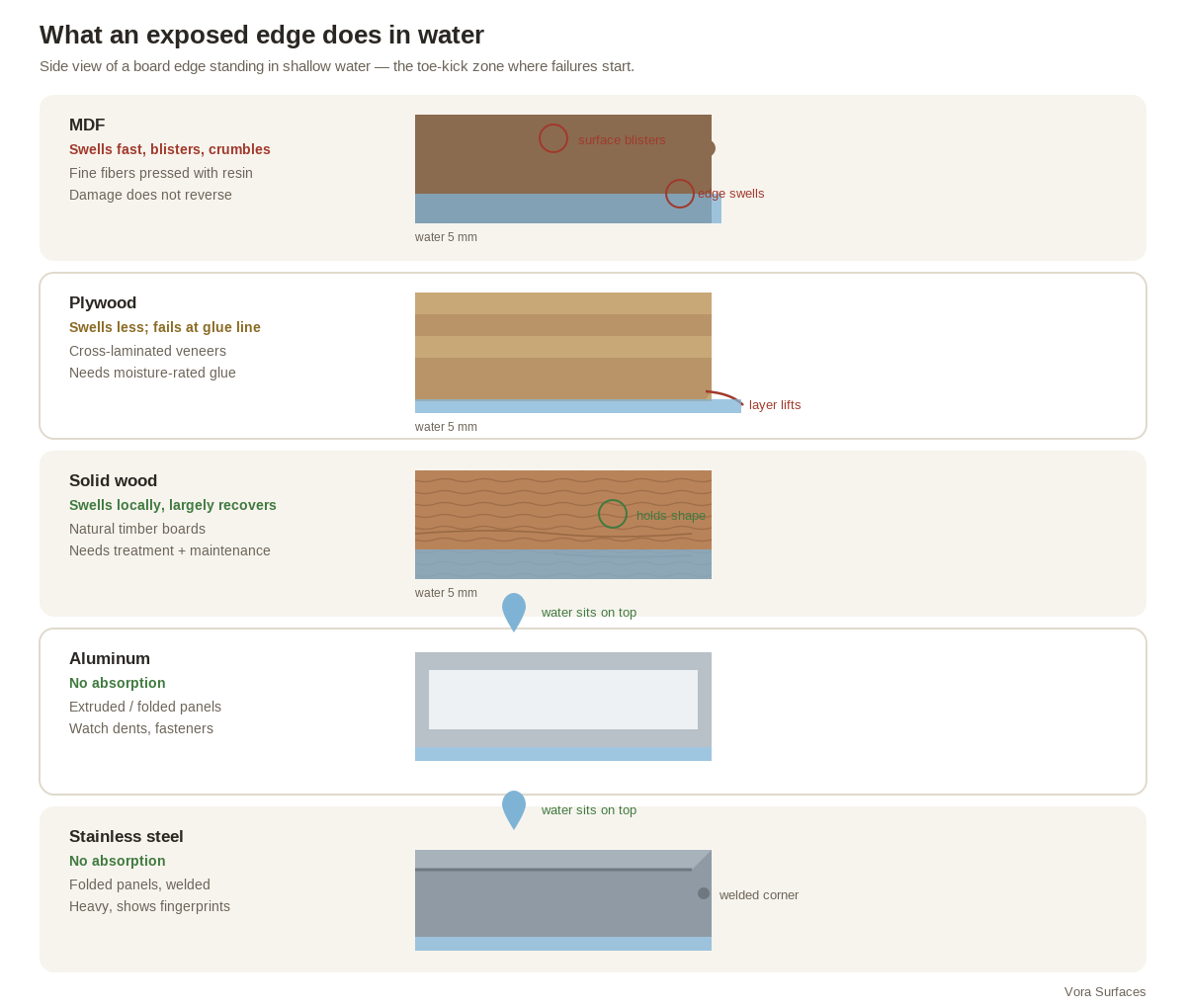
Cabinet moisture deformation dragging the hardware. A cabinet body that takes up moisture moves. Sides swell or twist by small amounts, slides fixed to those sides move out of parallel, drawer boxes bind, and hinge plates tilt. The hardware then takes the blame for a cabinet problem. Our guide to vanity cabinet construction for wet bathrooms covers how body materials and moisture-proof treatment affect that movement.
How can you check slides and hinges at delivery?
Three actions, done on every drawer and door while the delivery paperwork is still unsigned, give a reliable first verdict. They slot into the wider arrival routine covered in our guide to what to check when your vanity arrives — crate, stone, cabinet, then hardware.
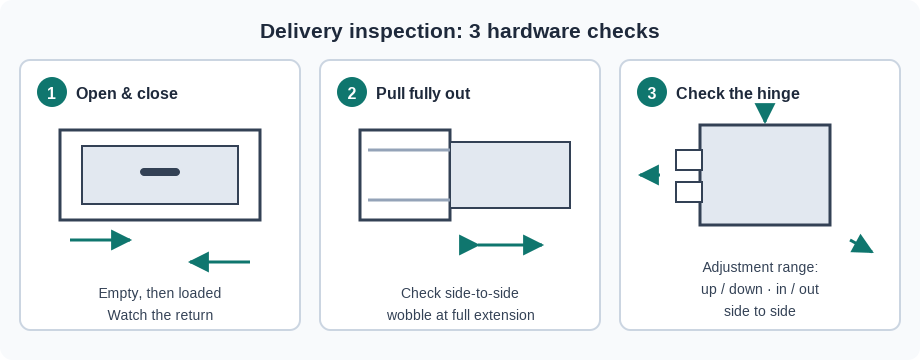
Action 1 — open and close each drawer empty, then loaded, and watch the return. Load the drawer with bottles or towels approximating daily contents. Push it to the point where the damper takes over and let go. Watch three things: the front lands flush against the cabinet face, the closing speed stays even through the damped stretch, and the drawer stays shut once closed. Repeat on every drawer: one weak damper in a set is a common pattern.
Action 2 — pull the drawer fully out and check lateral wobble. Draw the drawer to full extension, grip the front corners, and move the front side to side. Watch for wobble large enough to let the drawer box swing and strike the cabinet sides, and for travel that grinds or catches at one point along the slide. Run the drawer in and out twice more and feel for the same catch repeating at the same position.
Action 3 — check the hinge three-way adjustment range. Open each door and look at the hinge. A serviceable hinge adjusts in three directions: up and down, in and out, and side to side. Turn each adjustment screw a small amount and back again. You are checking that adjustment travel remains in reserve for the installer, and that door gaps read even with the screws near the middle of their range.
Record any fault with photos or a short video before signing, and note it on the delivery paperwork. A drawer that fails these checks on day one rarely improves with use.
What should you confirm with a supplier before ordering?
Four questions, answered in writing on the order, prevent most hardware disputes:
- Slide and hinge brand and grade. Ask which brand and grade of slides and hinges the price includes, and get the answer on the order confirmation. “Soft-close” alone describes a function; brand and grade describe the hardware delivering it.
- How full-load testing is done. Ask how the factory tests drawers under load before packing: how the drawers are loaded, how the cycling is done, and whether testing covers every unit or a sample.
- Adjustment and spare-parts supply. Ask who adjusts doors and drawers after installation, and how replacement slides, hinges, and dampers are supplied if one fails later. A supplier who stocks matching spare hardware for the models they ship can fix a single drawer cheaply.
- The moisture package of the cabinet. Ask how the cabinet body is built and treated against moisture, since cabinet movement drags hardware out of alignment. Hardware spec and cabinet construction belong on the same confirmation sheet.
These hardware items sit alongside the commercial terms of the order, and our MOQ and lead-time guide for sintered stone vanities covers quantity, sampling, and delivery timing.
How does Vora spec vanity hardware?
Vora cabinets pair solid-wood moisture-proof bodies with Kubo/DTC or equivalent-grade hardware, and buyers can confirm the hardware spec at order time. A stable, moisture-proof body gives the slides and hinges a fixed frame to work in, and a named hardware grade gives the buyer a spec to hold the order against. Buyer terms and documents are collected on our page for buyers, and current cabinet styles are shown in the cabinets collection.
FAQ
My soft-close drawer won’t shut fully — is it the hardware or the installation? Either cause is possible, and they feel similar from the front. Slides mounted slightly out of parallel, a hinge or drawer box out of square, and a swollen cabinet side can each hold a drawer off its closed position, and so can a weak or worn damper. The delivery checks separate the two: a drawer that travels smoothly by hand and only fails on the damped final stretch points to the hardware, while binding, scraping, or a front that sits crooked points to fit and adjustment.
How can I judge slide quality quickly at inspection? Run three actions. Open and close each drawer empty and loaded, and watch the return on the final stretch. Pull the drawer fully out and check side-to-side wobble at the front corners. Work each door and confirm the hinge still has adjustment range in three directions. Smooth travel, a front that lands flush, modest wobble, and adjustment travel in reserve add up to a pass.
Which hardware specs should I confirm with a supplier when ordering? Confirm four items in writing: the slide and hinge brand and grade, how full-load testing is done before packing, how adjustment and spare parts are handled after delivery, and the moisture package of the cabinet body the hardware mounts to. Vague answers on any of the four are a reason to press for detail before you commit.
Why do my soft-close drawers judder and shift the items inside? Judder usually means the two slides are fighting each other or the damper engages unevenly, so the drawer advances in small jerks and bottles slide around inside. Causes sit in three groups: hardware grade, mounting and adjustment, and cabinet movement from moisture.
Can a moisture-swollen cabinet make good hardware feel faulty? Yes. A cabinet side that takes up moisture and moves can push slides out of parallel and load hinge screws unevenly, so drawers bind and doors drift out of line even though the hardware itself is sound. That is why the ordering checklist pairs the hardware spec with the moisture package of the cabinet body.
Spec your next vanity order with the hardware in writing
Send your widths, cabinet style, and hardware questions through the inquiry form or the WhatsApp button, and the hardware spec will be confirmed on your order documents. To see the cabinet range the hardware ships in, browse the cabinets collection.
Replies come from the factory team — Roy handles buyer inquiries. Your inquiry details are used only for this inquiry, and we send no bulk mailing.
Specifications verified against Vora Surfaces factory records. Editorial review applied. Spotted an error? Email corrections to vorasurfaces@gmail.com.
Frequently asked questions
My soft-close drawer won't shut fully — is it the hardware or the installation?
Either cause is possible, and they feel similar from the front. Slides mounted slightly out of parallel, a hinge or drawer box out of square, and a swollen cabinet side can each hold a drawer off its closed position, and so can a weak or worn damper. The delivery checks separate the two: a drawer that travels smoothly by hand and only fails on the damped final stretch points to the hardware, while binding, scraping, or a front that sits crooked points to fit and adjustment.
How can I judge slide quality quickly at inspection?
Run three actions. Open and close each drawer empty and loaded, and watch the return on the final stretch. Pull the drawer fully out and check side-to-side wobble at the front corners. Work each door and confirm the hinge still has adjustment range in three directions. Smooth travel, a front that lands flush, modest wobble, and adjustment travel in reserve add up to a pass.
Which hardware specs should I confirm with a supplier when ordering?
Confirm four items in writing: the slide and hinge brand and grade, how full-load testing is done before packing, how adjustment and spare parts are handled after delivery, and the moisture package of the cabinet body the hardware mounts to. Vague answers on any of the four are a reason to press for detail before you commit.
Why do my soft-close drawers judder and shift the items inside?
Judder usually means the two slides are fighting each other or the damper engages unevenly, so the drawer advances in small jerks and bottles slide around inside. Causes sit in three groups: hardware grade, mounting and adjustment, and cabinet movement from moisture. The checks and root causes are covered in the body of this guide.
Can a moisture-swollen cabinet make good hardware feel faulty?
Yes. A cabinet side that takes up moisture and moves can push slides out of parallel and load hinge screws unevenly, so drawers bind and doors drift out of line even though the hardware itself is sound. That is why the ordering checklist pairs the hardware spec with the moisture package of the cabinet body.
Sourcing hot-bent basins for your next project?
Send your drawings and target quantities — we'll confirm feasibility from the factory floor.
Configure your inquirySee the products behind these guides: production cabinet styles and buying terms for buyers & OEM.
Specifications verified against Vora Surfaces factory records. Editorial review applied. Spotted an error? Email corrections to vorasurfaces@gmail.com.