
Factory guide
What Cabinet Construction Actually Survives a Wet Bathroom
The cabinet material that survives a wet bathroom is the one whose protection survives the bathroom. MDF, plywood, solid wood, aluminum, and stainless steel all fail differently when water finds a way in — and in a bathroom, it always does. What matters is how each construction behaves afterward, and what a buyer can check before ordering.
By Vora Surfaces Factory Editorial Team · Published 2026-10-10 · Foshan, China
In short: Solid wood with full moisture-proof treatment and sealed edges holds up well in a wet bathroom, and plywood with moisture-rated glue is a respectable middle ground. MDF is the riskiest choice for wet zones because it swells and crumbles once water reaches the fiber core. Metal cabinets ignore water but bring their own trade-offs. Judge the treatment and the joints — the material name alone tells you less than how it is protected.
Which cabinet material survives a wet bathroom?
Solid wood with complete moisture-proof treatment is among the most reliable timber options for wet bathrooms when fully treated; plywood with moisture-rated glue is the practical middle ground; MDF is the riskiest in constantly wet zones; aluminum and stainless steel absorb no water, at higher price and with dent risk. Treatment coverage and joint sealing usually decide more than the material label — as our solid-wood buying guide puts it: Judge the treatment details and the hardware grade — the material name on the spec sheet tells you less than what was done to protect it.
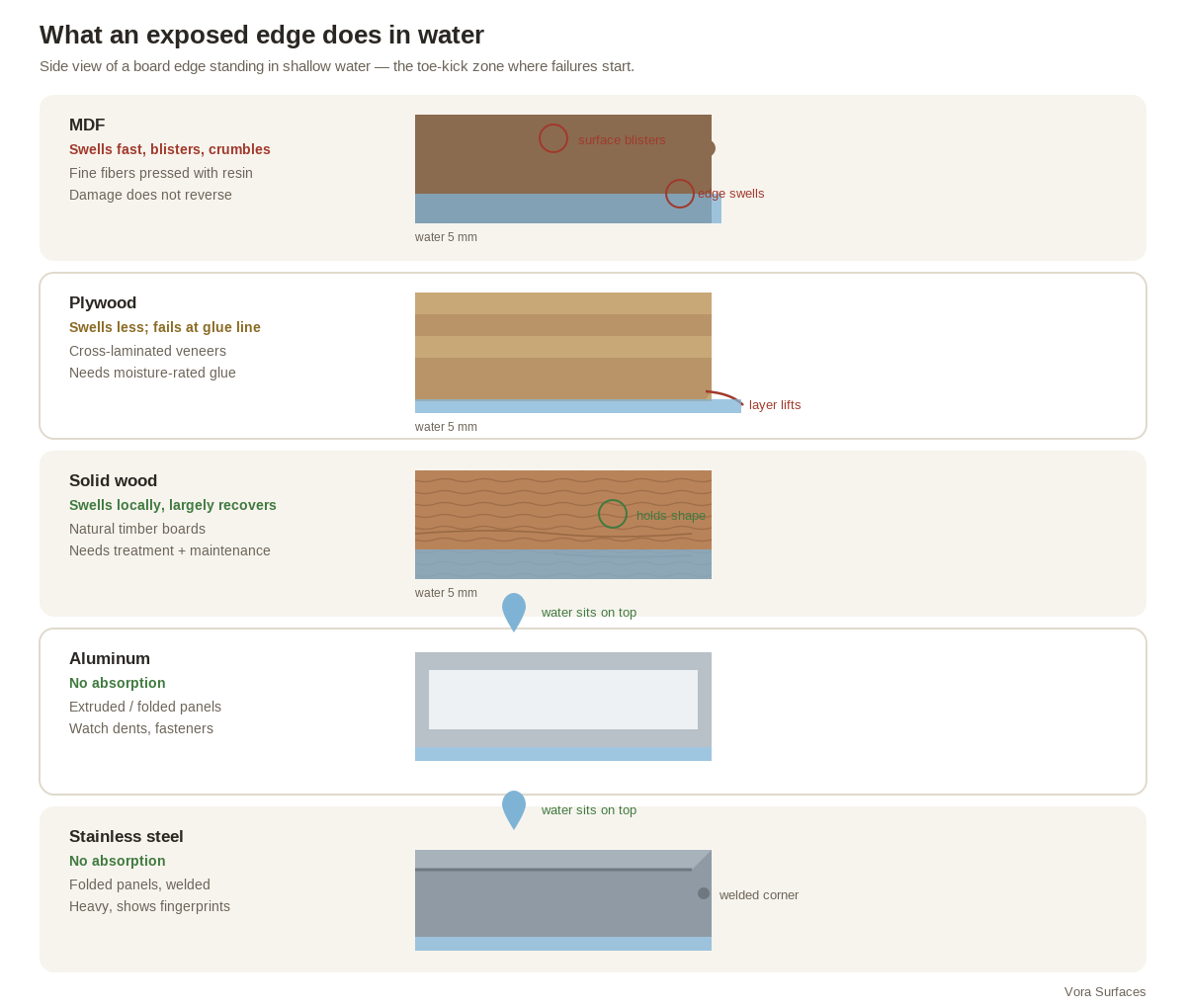
How each material behaves when water gets in
| MDF | Plywood | Solid wood | Aluminum | Stainless steel | |
|---|---|---|---|---|---|
| Core structure | Fine wood fibers pressed with resin | Thin wood veneers cross-laminated with glue | Natural timber boards | Extruded or folded aluminum panels | Folded stainless panels, welded or riveted |
| When water gets in | Swells fast, blisters, crumbles; does not recover shape once the core is wet | Swells less; resists well when the glue is moisture-rated | Swells locally around the entry point; largely recovers when dried, though long soaks can warp it | No absorption; water sits on the surface | No absorption; water sits on the surface |
| Typical bathroom failure | Toe-kick and bottom shelf swell first — the parts closest to floor water | Delamination at unsealed cut edges, especially plumbing holes | Finish cracks at a joint, moisture enters through the crack | Dents and scratches in the coating; corrosion at unprotected fasteners | Dents, visible fingerprints, higher cost per unit |
| How to identify it | Smooth uniform surface, heavy, soft screw grip at edges | Visible layered edge, lighter than MDF at the same size | Visible grain, joins with wood joinery, moves slightly with seasons | Lightweight, hollow ring when tapped, coated finish | Heavier than aluminum, metallic edges, welded corners |
| Suited for | Dry powder rooms with good ventilation | Mid-range wet bathrooms, budget builds that still need durability | Main bathrooms where buyers pay for longevity | High-humidity and commercial washrooms | Commercial and hygiene-critical projects |
Every material on this list survives only as long as its protection does — the sections below walk through each one, the failure to watch for, and a test you can run yourself.
MDF: the one buyers ask about most
MDF — medium-density fiberboard — dominates budget vanities because it machines beautifully: crisp edges, an even finish surface, and low cost. Its weakness is equally specific. MDF is pressed from fine wood fibers, and the dense surface only resists water until it is breached: any cut edge, drilled plumbing hole, or lifted edge-banding lets water into the core, which swells while the surface blisters and screws lose grip. The damage does not reverse when the piece dries.
A wholesale explainer reel from Aquiring Sanitary Ware Wholesale (observed 9 Oct 2026) captured exactly this anxiety. The opening line — “BUYING BATHROOM VANITIES? CHECK THREE THINGS” — frames the whole clip, and the first check warns that MDF absorbs water and swells in a damp bathroom. The purchase logic in that niche is simple, and it is about what survives.
Where MDF makes sense: a dry powder room with real ventilation. Where it deserves hard questions: any main bathroom, any household with children, any rental. Ask whether the cut edges are sealed, the underside treated, and the bottom shelf raised on a plinth.
Plywood: the middle ground with one condition
Plywood’s cross-laminated veneer layers give it two advantages in wet zones: it swells less than MDF and holds screws far better, so hinges and drawer slides stay anchored where MDF lets go. Its failure mode is delamination — layers separate when moisture attacks the glue, starting at unsealed cut edges and plumbing cutouts. The condition is the glue: moisture-rated adhesive holds together in steam and splashes, while interior-grade glue turns a wet bathroom into a slower version of the MDF story. Ask which adhesive grade the boards use, then check the edges yourself — an unsealed edge around a drain hole is where the failure starts.
Solid wood: where it wins, what it still needs
Solid wood has a strong reputation in bathrooms, and in practice the reputation mostly holds — with treatment doing the heavy lifting. A dense, well-finished timber board handles humidity that destroys fiberboard. The honest part sellers skip: good timber with careless moisture-proof treatment is a slow disaster. Steam finds every untreated cut edge and gap in the finish — once water gets under the coating, solid wood swells and the joints open.
At Vora Surfaces, our cabinet bodies are solid wood with moisture-proof treatment — that wording is the verified fact, and it stops there: we claim no specific process or standard beyond what our factory records confirm. Ask exactly which surfaces the treatment covers, how cut edges and plumbing holes are sealed, and whether the interior gets the same treatment as the exterior. Our 14 production cabinet styles are built on that construction; you can browse the cabinet range for the current lineup.
Solid wood still needs maintenance, and any honest guide says so. Wipe up standing water promptly, ventilate the room, and keep the finish coating intact. The finish is the cabinet’s raincoat, and raincoats fail at the seams: a hairline crack at a joint is a future water entry, so give joints a look when you clean. Small seasonal movement in humid weather is normal timber behavior, and the hardware should be spec’d to tolerate it. Hardware in our units is Kubo/DTC or equivalent-grade, which is the accurate wording for how we source it.
One system note: a treated cabinet pairs well with a basin that does not leak at the joint. A hot-bent one-piece sintered stone basin carries no glued seam where water usually collects and wicks down behind the cabinet. A continuous hot-bent curve has nothing to scrub around: one wipe, done. See the hot-bent basin range for the one-piece models that pair with these cabinets.
Aluminum and stainless steel: the metal options
Metal cabinets answer the moisture question by declining to participate: aluminum and stainless steel absorb no water, so nothing swells, delaminates, or rots. For high-humidity commercial washrooms, rental units, and hygiene-critical projects, that property alone often decides the spec.
The trade-offs are real. Aluminum dents and scratches show on coated finishes; corrosion starts at unprotected fasteners and cut edges. Stainless steel is heavier, costs more per unit, and shows fingerprints on brushed finishes. Choose metal when the moisture load is extreme or hygiene leads; choose timber when warmth and repairability matter.
The 3-minute water test any buyer can run
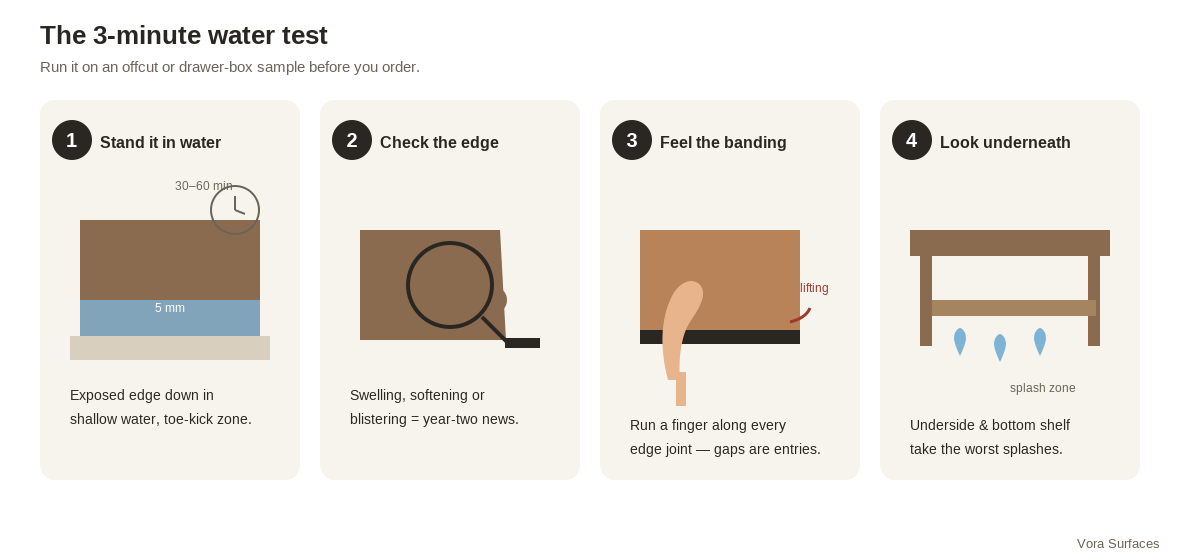
Factory reels of workers pouring water into drawers make a point, and you can run a smaller version before you order. Ask the supplier for an offcut or a drawer-box sample — any honest factory has them. Then:
- Stand the piece in shallow water. Set the exposed edge in about 5 mm of water for 30–60 minutes, simulating the toe-kick zone closest to floor water.
- Check the edge. Swelling, softening, or blistering tells you what happens in year two. Treated solid wood and well-glued plywood should look largely unchanged; MDF is likely to show its hand.
- Inspect the banding on a display model. Run a finger along every edge-banding joint and corner. Lifted corners and gaps are the entry points water uses — catch them in the showroom, not in the customer’s bathroom.
- Look underneath. The cabinet underside and bottom shelf take the worst of floor splashes. Ask whether those surfaces are sealed the same way as the visible faces.
If a supplier cannot provide a sample or a clear answer on edge sealing, that silence is an answer.
FAQ
Which vanity cabinet material should I choose for a wet bathroom? Solid wood with moisture-proof treatment and sealed edges holds up well in a wet bathroom; plywood with moisture-rated glue is a respectable middle ground. MDF is the least forgiving because it swells and crumbles once water reaches the core. Metal absorbs no water but costs more and dents more easily.
What happens to MDF in a humid bathroom? MDF’s dense surface resists brief splashes, but any cut edge, drilled hole, or lifted edge-banding lets water into the fiber core. The core swells, the surface blisters, screws lose grip, and the damage does not reverse when it dries.
Is plywood good for a bathroom vanity? Plywood’s cross-laminated layers hold screws well and swell less than MDF, provided the glue is moisture-rated. Check that cut edges and plumbing holes are sealed — those are the entry points for steam and splashes.
Does a solid wood vanity need maintenance in a bathroom? Yes. Treated solid wood handles humidity far better than fiberboard, but it still needs basic care: wipe up standing water, ventilate the room, and keep the finish coating intact. Finish cracks at joints are where water enters, so inspect them when you clean.
Can I test a vanity cabinet for moisture resistance before ordering? Ask the supplier for an offcut or drawer-box sample and stand it in shallow water for 30–60 minutes; check whether the exposed edge swells or delaminates. On display models, run a finger along every edge-banding joint — lifted corners signal where water will enter.
What cabinet construction does Vora Surfaces use? Solid wood cabinet bodies with moisture-proof treatment, paired with hot-bent one-piece sintered stone basins formed in-house. The range includes 14 production cabinet styles on the cabinets collection page.
Ask about the construction before you order
The buyers who get the most years out of a vanity are the ones who asked about edge sealing, treatment coverage, and hardware grade before ordering. To compare, browse the cabinet range for the current production styles, explore size and finish options in the configurator, or send an inquiry with your width and quantity.
Inquiries go to our Foshan sales desk and are used only for this inquiry — no mailing list, English reply.
Frequently asked questions
Which vanity cabinet material should I choose for a wet bathroom?
Solid wood with moisture-proof treatment and sealed edges holds up well in a wet bathroom; plywood with moisture-rated glue is a respectable middle ground. MDF is the least forgiving because it swells and crumbles once water reaches the core. Metal absorbs no water but costs more and dents more easily.
What happens to MDF in a humid bathroom?
MDF's dense surface resists brief splashes, but any cut edge, drilled hole, or lifted edge-banding lets water into the fiber core. The core swells, the surface blisters, screws lose grip, and the damage does not reverse when it dries.
Is plywood good for a bathroom vanity?
Plywood's cross-laminated layers hold screws well and swell less than MDF, provided the glue is moisture-rated. Check that cut edges and plumbing holes are sealed — those are the entry points for steam and splashes.
Does a solid wood vanity need maintenance in a bathroom?
Yes. Treated solid wood handles humidity far better than fiberboard, but it still needs basic care: wipe up standing water, ventilate the room, and keep the finish coating intact. Finish cracks at joints are where water enters, so inspect them when you clean.
Can I test a vanity cabinet for moisture resistance before ordering?
Ask the supplier for an offcut or drawer-box sample and stand it in shallow water for 30–60 minutes; check whether the exposed edge swells or delaminates. On display models, run a finger along every edge-banding joint — lifted corners signal where water will enter.
What cabinet construction does Vora Surfaces use?
Solid wood cabinet bodies with moisture-proof treatment, paired with hot-bent one-piece sintered stone basins formed in-house. The range includes 14 production cabinet styles — see [the cabinets collection](/collections/cabinets/).
Sourcing hot-bent basins for your next project?
Send your drawings and target quantities — we'll confirm feasibility from the factory floor.
Configure your inquirySee the products behind these guides: production cabinet styles and buying terms for buyers & OEM.
Specifications verified against Vora Surfaces factory records. Editorial review applied. Spotted an error? Email corrections to vorasurfaces@gmail.com.